

 dinero_admin
El Salvador’s imports reached US$1,884.71 million in october 2026, an increase of US$187.54 million, equivalent to 11.05%, compared to the US$1,697.17 million recorded in september, according to preliminary figures from the Banco Central de Reserva (BCR).
Monthly growth by sector
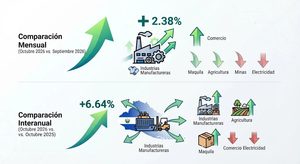
Five of the six economic sectors recorded increases. The largest percentage change was in mining and quarrying, where imports rose from US$11.22 million to US$31.11 million. This represented an increase of US$19.89 million, equivalent to 177.27%.
This was followed by the maquila manufacturing sector, which grew by US$8.83 million (25.01%), rising from US$35.30 million in september to US$44.13 million in october. Meanwhile, agriculture, livestock, forestry, and fishing increased by US$9.17 million (12.21%), rising from US$75.14 million to US$84.31 million.
Wholesale and retail trade, including vehicle repairs, recorded an increase of US$0.92 million (13.16%), rising from US$6.99 million to US$7.91 million. Meanwhile, the manufacturing sector saw the highest growth in monetary terms: its imports rose by US$151.51 million (9.68%), from US$1,565.02 million to US$1,716.53 million. This sector accounted for 91.1% of total imports in october.
Electricity was the only sector to decline
The only monthly decline was recorded in the supply of electricity, gas, steam, and air conditioning. Imports in this sector fell from US$3.51 million in september to US$0.72 million in october, a decrease of US$2.79 million, equivalent to 79.49%. No other sector maintained the same level of imports.
Comparison with october 2025
On a year-over-year basis, imports grew by 18.85%, rising from US$1,585.88 million in october 2025 to US$1,884.71 million in october 2026. This represented an increase of US$298.83 million, and all six economic sectors recorded positive changes.
The manufacturing sector accounted for the largest increase in dollar terms, with an additional US$246.59 million (16.78%), rising from US$1,469.94 million to US$1,716.53 million. In contrast, the largest percentage change was once again seen in mining and quarrying, where imports rose from US$1.95 million to US$31.11 million, an increase of US$29.16 million (1,495.38%).
Agriculture, livestock, forestry, and fishing increased by US$16.55 million (24.43%), while the maquila manufacturing industry grew by US$5.26 million (13.53%). Wholesale and retail trade, including vehicle repairs, added an additional US$0.93 million (13.32%). Meanwhile, the supply of electricity, gas, steam, and air conditioning recorded an increase of US$0.34 million (89.47%).
The manufacturing sector accounted for the largest contribution
The results show that the manufacturing sector was the main driver of import growth, both on a month-over-month and year-over-year basis, due to the volume of foreign purchases in this sector. Mining and quarrying, although accounting for smaller amounts, stood out for recording the largest percentage increases in both periods.
The figures are based on preliminary data from october 2026 published by BCR, compiled using information from the General Directorate of Customs and fuel distributors, in accordance with balance-of-payments methodology.
You can also read: