

 dinero_admin
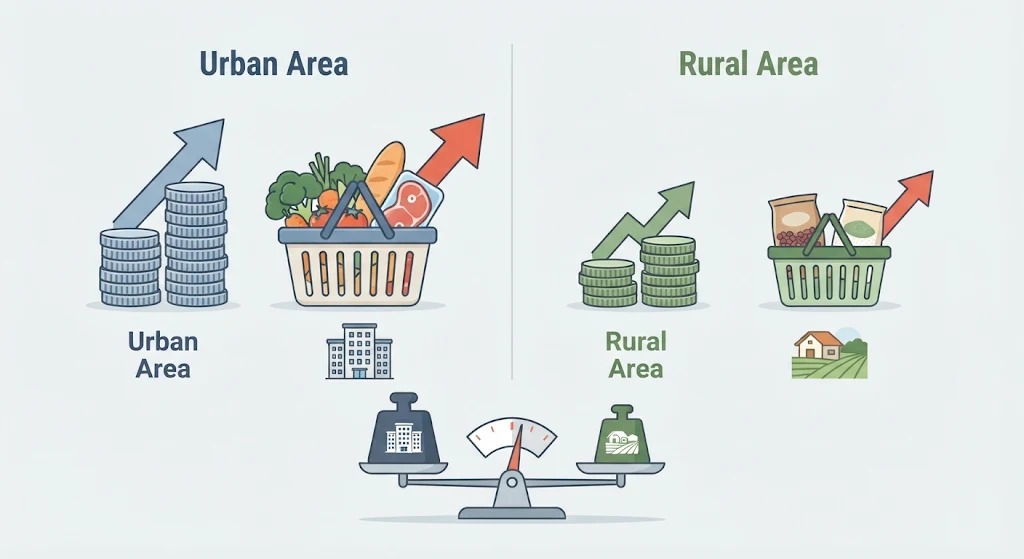
The monthly cost of the basic food basket per family increased in october 2026 in El Salvador, in both urban and rural areas, according to data from the Banco Central de Reserva (BCR). However, the increase was considerably higher in cities, where household spending rose from US$269.15 in september to US$274.47 in october, while in rural areas it rose from US$191.04 to US$191.67.
Larger increase in urban areas
In urban areas, the basic food basket rose by US$5.32 in october, equivalent to a monthly increase of 1.98%. This means that families in these areas needed more money to cover the foods included in the basket compared to the previous month.
In rural areas, the increase was more moderate. The cost rose from US$191.04 in september to US$191.67 in october, representing an additional US$0.63, equivalent to 0.33%. Thus, the urban increase was higher both in dollar terms and as a percentage.
The difference between the two sectors was also reflected in the total cost. In october, an urban family needed US$82.80 more than a rural family to cover the monthly basic food basket.
The BCR’s calculation is based on an average family of 3.73 members in urban areas and 4.26 members in rural areas. It also includes an additional 10% for cooking expenses.
Vegetables and meats drove up urban costs
Among the products that contributed to the increase in the urban basket, vegetables stood out, recording the largest increase among food groups. This category includes potatoes, onions, green chilies, tomatoes, güisquil, and cabbage, and saw a 14.41% increase.
French bread also rose by 2.30%; beans, by 1.05%; and meats, by 0.55%. Added to these products were tortillas, which rose by 0.51%, and sugar, with an increase of 0.62%.
As for food items that fell in price in urban areas, fruits recorded the largest decrease, with a 3.13% drop. This group includes oranges, plantains, and bananas. Eggs also fell by 0.96%; rice, by 0.23%; and fats, by 0.08%.
Meanwhile, the price of fluid milk remained unchanged. Despite the decreases seen in some food items, these were not enough to offset the increase in vegetables and other products whose prices rose.
Tortillas and beans drove the increase in rural areas
In rural areas, food prices behaved differently. The largest increase was for tortillas, with a 0.52% change. Beans also recorded a 1.09% increase. These were joined by meat, which rose 0.55%, and sugar, with a 0.65% increase.
In contrast, fruit prices fell by 2.70%. Egg prices also dropped by 0.97%, while rice prices decreased by 0.16%.
Fluid milk and fats remained unchanged. Unlike the urban basket, the rural basket presented by the BCR does not include a vegetable group, so this category does not appear among the factors contributing to price changes in that area.
Year-over-year comparison: the urban basket shows a greater increase in prices
When comparing october 2026 with the same month in 2025, a significant difference is also observed between the two sectors. In urban areas, the basic basket rose from US$250.75 to US$274.47, representing an increase of US$23.72, equivalent to 9.46% over the course of a year.
In rural areas, the cost rose from US$190.11 in october 2025 to US$191.67 in october 2026. The difference was US$1.56, representing a 0.82% increase.
The data show that the rise in the cost of the basic basket of goods was much more pronounced in urban areas, both on a monthly and annual basis. While urban households faced an increase of US$5.32 in october compared to september, in rural areas the increase was just US$0.63. Likewise, on an annual basis, the 9.46% increase in urban areas far exceeded the 0.82% recorded in rural areas.
You can also read: