


 dinero_admin
The Fondo Social para la Vivienda (FSV) closed 2025 with a historic investment of US$1.06274 billion in housing loans, an effort that benefited 46,047 salvadoran families during President Nayib Bukele’s administration. This amount reflects one of the government’s strongest commitments to revitalizing the housing sector, boosting the economy, and facilitating access to home ownership for thousands of households throughout the country.
According to official FSV data, most of this investment was concentrated in loans for used homes and other lines, which totaled US$480.15 million, benefiting 24,078 families. Added to this are loans for new homes, with an investment of US$454.62 million allocated to 12,385 families, strengthening housing development and construction, a key sector for job creation and economic growth.

A significant component of this investment corresponds to extraordinary assets, which reached US$127.97 million and enabled the delivery of 9,584 homes. These houses, which were previously abandoned, squatted in, or in poor condition, were recovered and rebuilt thanks to the improved security situation in the country, once again becoming homes for thousands of salvadoran families.
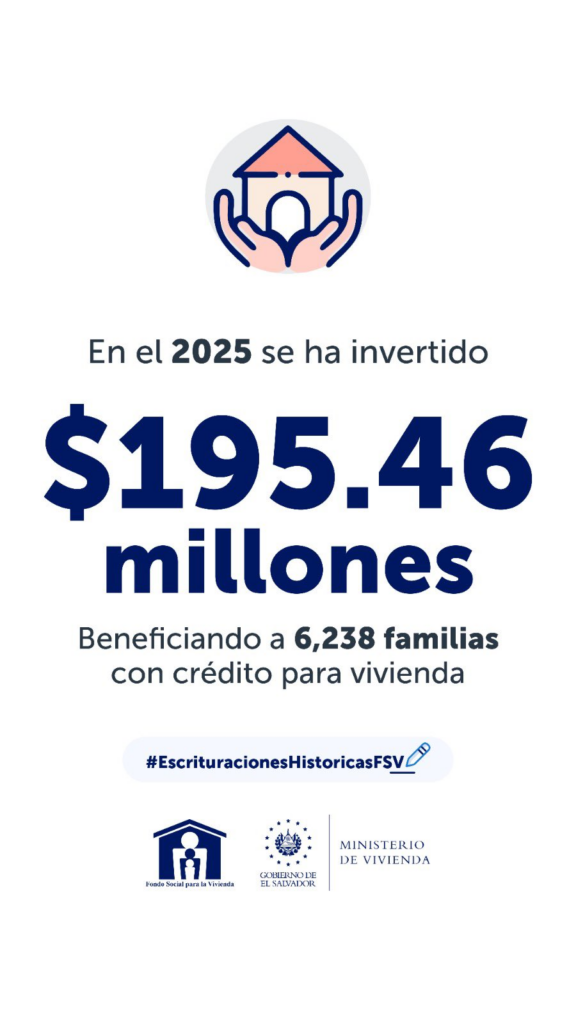
In 2025, the FSV reported an annual investment of US$195.46 million, benefiting 6,238 families and making this year the one with the highest level of land titling in the institution’s history. This result demonstrates a sustained strengthening of the Fund’s financial and operational capacity, as well as increased demand for housing loans.
During the year, investment was distributed as follows: US$103.79 million for new housing, with 2,542 loans granted; US$79.85 million for used housing and other lines, benefiting 2,965 families; and US$11.82 million in extraordinary assets, allocated to 731 homes. This diversification made it possible to serve different family profiles and housing needs.
FSV investment not only directly impacts beneficiary families but also has multiplier effects on the economy. Housing financing stimulates construction, the purchase of materials, professional services, and local commerce, generating employment and economic activity in different sectors.
With these results, the Fondo Social para la Vivienda consolidates its role as one of the government’s main tools for facilitating access to decent housing, while contributing to the country’s economic and social development. The cumulative investment during the current administration sets a precedent in housing finance and reflects a sustained policy aimed at improving the quality of life of salvadoran families.
You can also read: