

 dinero_admin
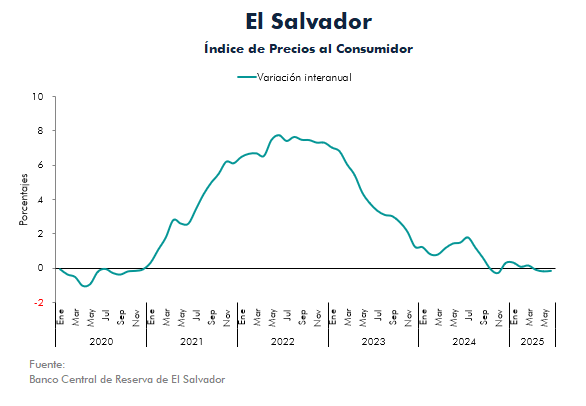
The latest data from the Precios al Consumidor (IPC) for Central America and the Dominican Republic (CARD), released by the Central American Monetary Council through the CMCA Executive Secretariat (SECMCA), indicate that El Salvador closed december 2025 with a year-on-year inflation rate of 0.91%, one of the lowest rates in the region.
This result is well below the regional average, which reached 2.60%, and reflects a relatively stable price environment in the Salvadoran economy during the past year.
Factors explaining the 0.91% inflation rate in El Salvador:
The country’s inflationary behavior was determined by a combination of moderate increases in some sectors and reductions in others, which helped to contain overall price growth.
One of the components with the greatest impact was food and non-alcoholic beverages, which saw moderate increases associated with factors such as import costs, transportation, and regional weather conditions affecting agricultural supply. However, these increases were smaller compared to other countries in the region, which helped keep inflation at low levels.
The hotel and restaurant sector registered a year-on-year variation of approximately 3.94%, driven by the recovery in consumption and the dynamism of tourism. This sector reflected higher prices for services related to lodging and food outside the home, although its impact was offset by reductions in other components of the CPI.
Key divisions such as transportation and communications showed negative variations, which contributed to reducing inflationary pressure. In transportation, the evolution of fuel prices and stabilization policies had an impact, while in communications, competition in the sector and the reduction of technological costs played a role.
Other sectors, such as furniture and household goods, clothing and footwear, and recreation and culture, showed moderate or negative variations, reflecting stable consumption and a sufficient supply of goods—factors that helped contain price growth.
Meanwhile, health and education registered slight increases, consistent with gradual adjustments in service prices, without generating significant pressure on overall inflation.
Contribution of sectors to inflationary behavior
The SECMCA analysis shows that food, housing and basic services, and hotels and restaurants were the main positive contributors to year-on-year inflation. In contrast, transportation and communications had negative contributions, which helped offset increases in other sectors.
This balance between upward and downward pressures allowed overall inflation to remain close to 1%, consolidating El Salvador’s position among the economies with the greatest price stability in Central America.
Regional comparison
At the regional level, inflation behavior was heterogeneous. Costa Rica registered a year-on-year inflation rate of -1.23%, reflecting a deflationary scenario. Guatemala reported 1.65%, while Honduras reached 4.98%, one of the highest rates in the bloc. Nicaragua closed at 2.70% and the Dominican Republic at 4.95%, both with higher inflationary pressures than those observed in El Salvador.
Overall, the regional average for the CARD bloc stood at 2.60%, showing that El Salvador was below the regional average.
Inflation Outlook
According to regional projections compiled by SECMCA, inflation in El Salvador could remain at moderate levels in 2026, close to its price stability target, although subject to external factors such as the evolution of international food and energy prices, as well as global financial conditions.
The 2025 year-end inflation rate of 0.91% confirms a price stability environment in El Salvador, in contrast to other economies in the region facing greater inflationary pressures, reinforcing the perception of a relatively controlled macroeconomic context in the country.
You can also read: