

 dinero_admin
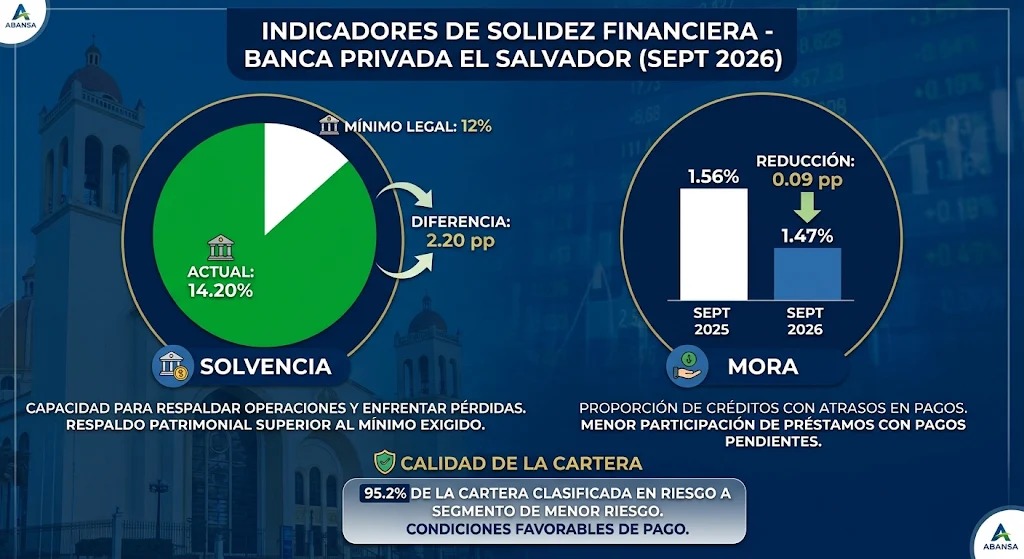
El Salvador’s private banking sector maintains financial strength indicators above the minimum levels required by regulation, according to data released by the Asociación Bancaria Salvadoreña (ABANSA). As of september 2026, the sector’s solvency ratio stood at 14.20%, while the delinquency rate fell to 1.47%.
According to the association, the solvency level exceeded the required legal minimum of 12%, a margin of 2.20 percentage points. This indicator serves to assess the capacity of banking institutions to support their operations and absorb potential losses arising from the risks inherent in their financial activities.
Maintaining a solvency ratio above the regulatory threshold means that banks possess a capital cushion that exceeds the required minimum. This is vital for the stability of the financial system, as it ensures that institutions are better positioned to respond to situations that might impact their operations or the recovery of granted loans.
Another key indicator highlighted by ABANSA is the delinquency rate, which stood at 1.47% as of september 2026. This figure represents a decrease from the 1.56% recorded in september 2025, a reduction of 0.09 percentage points over the year.
The delinquency rate measures the proportion of loans with overdue payments relative to the total credit portfolio. Consequently, a decline in this indicator reflects a smaller share of loans with outstanding payments within the total financing provided by banking institutions.
The association also reported that 95.2% of the loan portfolio is classified under risk category A. This classification represents the lowest-risk segment among credit categories, indicating that most loans maintain favorable repayment conditions, in accordance with the financial system’s evaluation criteria.
This result complements solvency and delinquency indicators, as it provides insight into the quality of the loans held by banks. A portfolio concentrated primarily in category A serves as a positive signal regarding the performance of the financing provided and the clients’ ability to meet their obligations.
Based on these results, ABANSA highlighted the strength of the salvadoran private banking sector as of september 2026, supported by a solvency level exceeding the legal minimum, a reduction in delinquency compared to the previous year, and a high proportion of loans falling into the lowest-risk category.
You may also read: