

 A. M.
A. M. 
The economic performance of the member countries of the Organización para la Cooperación y el Desarrollo Económicos (OCDE) showed mixed signs at the close of 2025, although with an improvement in the annual balance compared to previous years. The most recent national accounts data reveal that, while growth lost some momentum in the last quarter, the year ended with stronger expansion across the bloc.
The fastest-growing countries
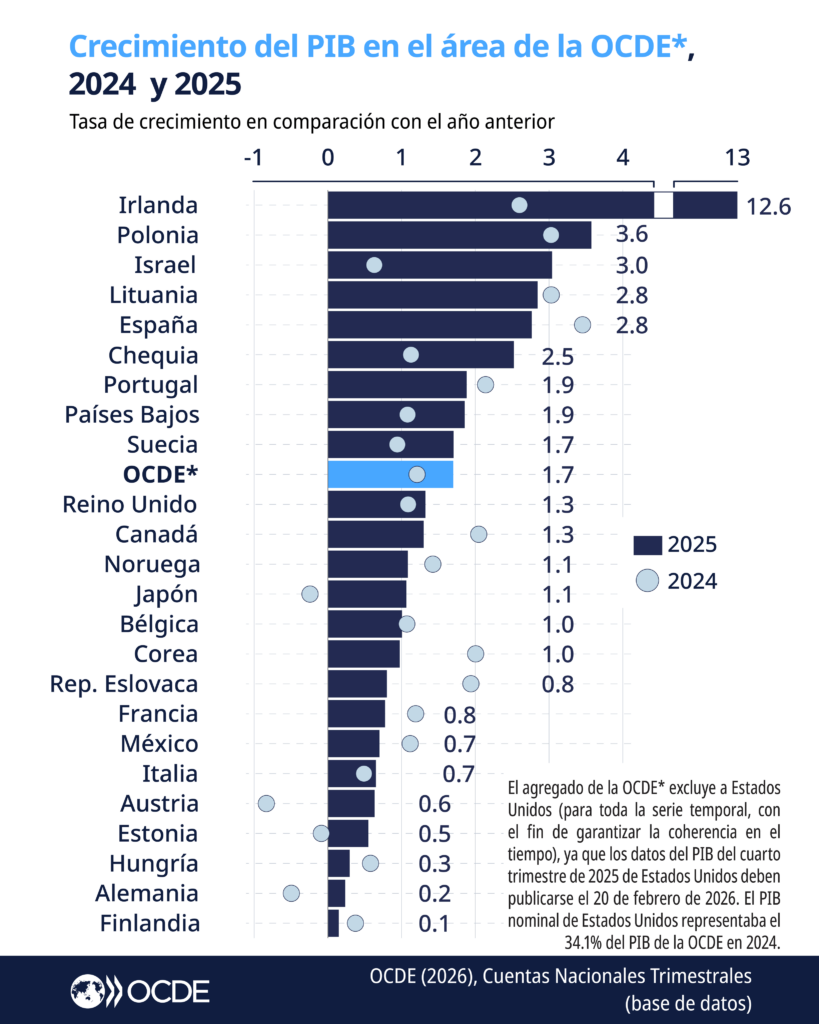
In annual terms, Ireland stood out significantly with GDP growth of 12.6% in 2025, the highest among the 24 countries with available data. This result positions it as the fastest-growing economy within the group during the year.
In the quarterly analysis (comparing the fourth quarter with the third quarter of 2025), Lithuania registered the largest increase, with growth of 1.7%. Israel and Poland also stood out, both with growth of 1.0% in the same period, reflecting solid performance toward the end of the year.
Across the OECD, annual GDP growth reached 1.7% in 2025, surpassing the 1.2% observed in 2024 and the 1.1% of 2023. This indicates a moderate acceleration in the pace of economic expansion compared to the previous two years.
Developments in the main G7 economies
Within the G7, performance was mixed. Germany and Italy showed acceleration in the fourth quarter, both reaching 0.3% growth. In these cases, the boost came mainly from household consumption and government spending; in Italy, increased investment also contributed.
Japan managed to move out of negative territory and registered 0.1% growth in the fourth quarter, after a 0.7% contraction in the third, driven primarily by a recovery in investment.
Conversely, France slowed its pace of expansion to 0.2%, affected by inventory reductions. Canada went from growing 0.6% in the third quarter to contracting 0.1% in the fourth, while the United Kingdom maintained slight growth of 0.1%. Fourth-quarter data for the United States were not available at the time of publication.
Countries with setbacks and the overall outlook
In the fourth quarter of 2025, five OECD economies experienced contraction. Among the most notable cases were Ireland, with a quarterly decline of 0.6%, and Korea, with a decrease of 0.3%.

In total, of the 24 countries analyzed:
• Ten registered an increase in their growth rate compared to the previous quarter.
• Two showed no change.
• Seven showed slower growth.
• Five experienced contraction.
As a result, the OECD’s average quarterly growth moderated slightly to 0.3% in the fourth quarter, down from 0.4% in the third.
However, the annual balance was more favorable: unlike 2024, when seven countries reported GDP contractions, in 2025 all economies with available data managed to end the year with positive growth. This reflects a broader recovery within the bloc, although with marked differences in the speed and strength of performance among countries.
You can also read: