

 dinero_admin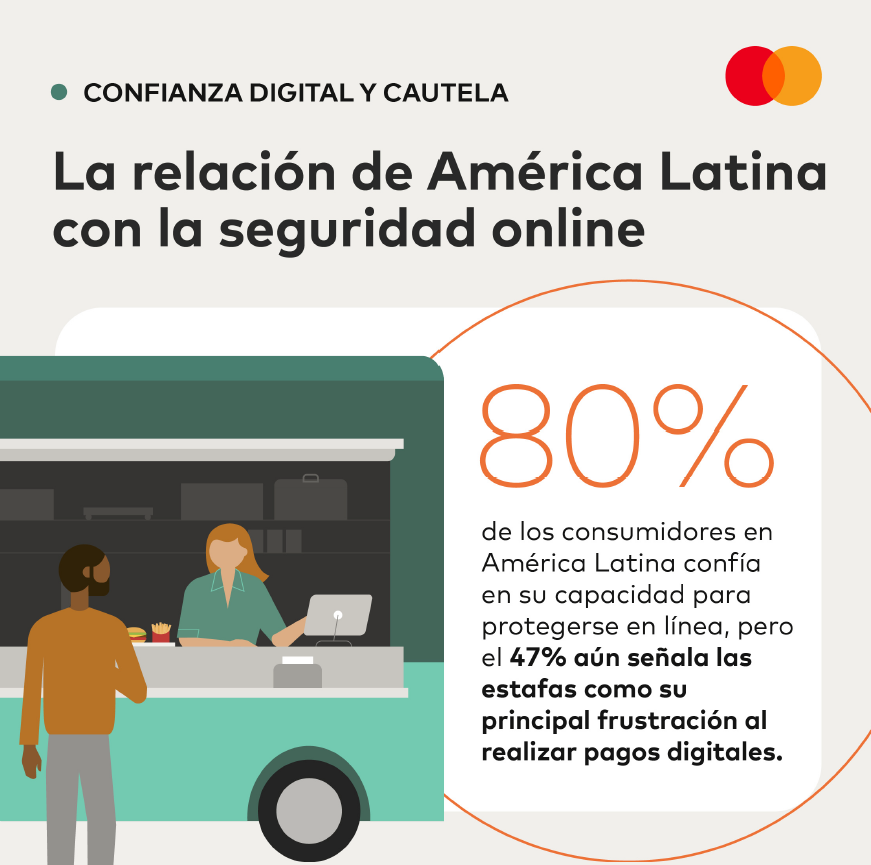
Mastercard presented the results of its most recent regional survey focused on perceptions of cybersecurity in Latin America and the Caribbean. The study reveals that, as digital payments become part of daily life and convenience increases, a new paradigm is emerging in the region: while consumers feel increasingly confident in their ability to navigate the digital world, fear of fraud and scams remains their greatest concern.
According to the survey, eight out of ten Latin Americans (80%) say they feel capable of protecting themselves online—a clear indicator of growing digital maturity in the region. However, nearly half (47%) identify fraud and scams as their main frustration when conducting digital transactions, highlighting a critical tension between trust and caution in an era of increasing financial inclusion.
“As the region continues on its path of digital transformation, people live in a dual reality: they are secure, increasingly digitally savvy, and open to innovation, but also aware that scams are becoming more sophisticated,” said Ana Lucia Magliano, Executive Vice President of Services for Mastercard Latin America and the Caribbean. “These data reinforce the collective opportunity to close the trust gap with solutions that help organizations and consumers stay ahead of threats.”
To protect people in the digital environment, Mastercard goes beyond securing transactions to protect every interaction. The company uses artificial intelligence, advanced analytics, and behavioral modeling to anticipate and prevent threats before they occur—backed by an $11 billion investment in cybersecurity over the past five years. Recently, Mastercard launched Mastercard Threat Intelligence, the first solution of its kind to apply large-scale threat intelligence across the payments ecosystem, enabling banks to detect and respond to emerging threats before fraud occurs.
Digital Trust with Caution
Consumer participation in digital finance has increased across the region: debit cards (89%) and credit cards (84%) already dominate everyday transactions. New payment technologies are also on the rise—real-time transfers (79%) and digital wallets (74%) are growing rapidly as consumers seek speed and convenience.
However, this same momentum has brought new concerns. Beyond fraud and scams, privacy concerns (32%) related to the use or sharing of personal or financial data continue to generate uncertainty. The rise of AI-driven fraud, including deepfakes and voice cloning, is especially alarming, cited by 43% of respondents as an emerging threat that is redefining perceptions of security.
The New Face of Fraud
Traditional scams are evolving rapidly. Phone or voice scams remain the most common type of fraud in the region (32%), followed by social media attacks and phishing. These increasingly technology-driven tactics make it difficult even for the most savvy consumers to distinguish real from fake, fueling both vigilance and frustration.
Trust and Transparency: Keys to Digital Growth
The data also underscore the importance of trust in sustaining digital adoption. Banks (89%) and payment networks like Mastercard (82%) emerged as the most trusted institutions to safeguard money and data. This trust is an essential pillar for digital growth in a region where inclusion and innovation are transforming how payments are made and received.
Consumers also expressed clear preferences for features that reinforce their sense of security:
- Proactive alerts and monitoring tools (59%)
- Clear fraud protection and reimbursement policies (57%)
- Stronger authentication methods such as biometrics or passkeys (53%)
These expectations reveal an opportunity for the industry: combining education, transparency, and intuitive security design that empowers users without slowing digital progress.
Combining Innovation and Security
Even as threats evolve, optimism remains. More than half of consumers say they are more excited about faster and simpler payments (51%) and more secure online checkout based on biometrics and tokenization (31%), innovations that combine convenience and trust.
“These findings show that the digital economy will continue to accelerate when we make security and trust inseparable from innovation,” added Magliano. “People want visible security—such as alerts or biometrics—backed by strong protections that act invisibly.”
During the Annual Innovation Forum this December, Mastercard explores how it is securing the digital ecosystem with Mastercard Threat Intelligence, as well as other solutions that help businesses grow, digitize, and protect their operations. Read more about all of Mastercard’s activities at the conference.
Scope and Methodology of the Study
The study was led by Mastercard and conducted by the independent agency Many Minds Group. In October 2025, an online quantitative survey was conducted among 3,577 adults in 12 countries in Latin America and the Caribbean: Argentina, Brazil, Chile, Colombia, Costa Rica, Dominican Republic, Ecuador, Guatemala, Mexico, Panama, Peru, and Puerto Rico. The sample included banked consumers who had made e-commerce purchases or used online banking in the past six months, representing the active digital population aged 18 to 65.