

 dinero_admin
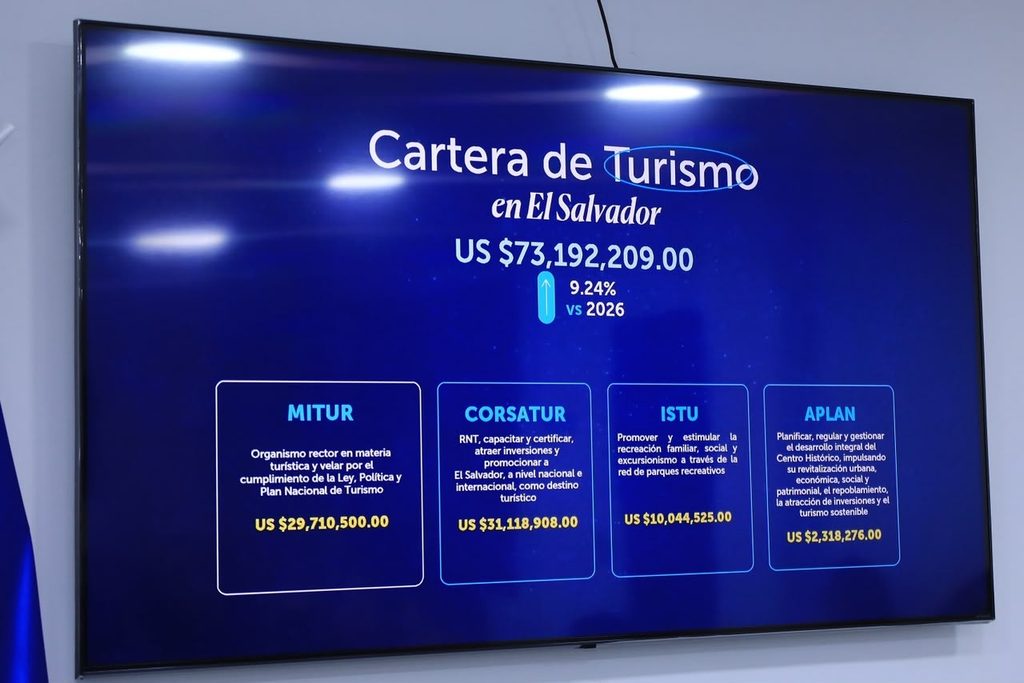
The tourism sector is projected to contribute 14% to El Salvador’s Gross Domestic Product (GDP) by 2027, an increase of four percentage points over the contribution projected for 2026. To reach this goal, the government plans to allocate US$73.19 million toward strengthening tourist destinations, international promotion, infrastructure development, and human capital training, as explained by minister of Tourism Morena Valdez to the Legislative Assembly’s Finance Committee.
The minister detailed that the funds requested for the coming year will support ongoing strategies to position the country as a regional and international tourist destination, while also fostering new investments and expanding the range of locations available to both domestic and international visitors. Of the sector’s total budget, the Ministerio de Turismo (MITUR) would receive US$29.71 million; the Corporación Salvadoreña de Turismo (CORSATUR), US$31.11 million; the Instituto Salvadoreño de Turismo (ISTU), US$10.04 million; and the Planificación del Centro Histórico de San Salvador (APLAN), US$2.31 million.
Key projects planned for 2027 include the enhancement of tourist destinations in the eastern region. Eco-friendly boardwalks and urban corridors are set to be built at the El Tamarindo and El Esterón beaches in La Unión, while tourist viewpoints will be developed in Berlín and Punta Mango, located in Usulután. Additionally, an adventure park is planned for Altos de la Cueva in San Miguel, aimed at broadening recreational options and attracting visitors to these departments.
The strategy also encompasses improving the training of personnel working in tourism-related activities. To this end, training programs will be implemented, covering language skills, technical training in gastronomy, and specialization in priority tourism sectors. These initiatives aim to enhance service quality and improve the experience for international visitors, a key step toward strengthening the country’s competitiveness relative to other destinations in the region.
Valdez highlighted that the tourism sector continues to perform well; between january and october 2026, El Salvador welcomed 3.9 million international visitors, generating US$3.098 billion in foreign currency, a 12% increase compared to the same period in 2025. The minister also noted that 4.1 million tourists arrived in 2025, and that Guatemala remains a major market, with 1.6 million visitors from that country in 2026.
To sustain this momentum, CORSATUR will continue its international promotional efforts, event organization, and outreach to potential investors. The institution is also collaborating with businesses linked to the sector, including hotels, restaurants, transport operators, and recreational service providers, to bolster the tourism offering and create conditions that attract new investment projects.
Meanwhile, the ISTU will focus its resources on boosting domestic tourism and continuing the restoration of infrastructure within state-managed natural, recreational, and water parks. Its initiatives include the “Buses Alegres” cultural and gastronomic festivals, and markets for local entrepreneurs, activities designed to stimulate the local economy and expand entertainment options for salvadoran families.
Complementing these efforts, APLAN will work on the Historic Center of San Salvador, with plans to advance the design of new public squares, urban corridors, and districts specialized in art, fashion, and innovation. According to representatives from these institutions, a combination of international promotion, the development of new destinations, infrastructure improvements, human talent training, and the revitalization of public spaces will form part of the strategy to strengthen tourism activity and reach the goal of having this sector contribute 14% to El Salvador’s GDP by 2027.
You can also read: