


 dinero_admin
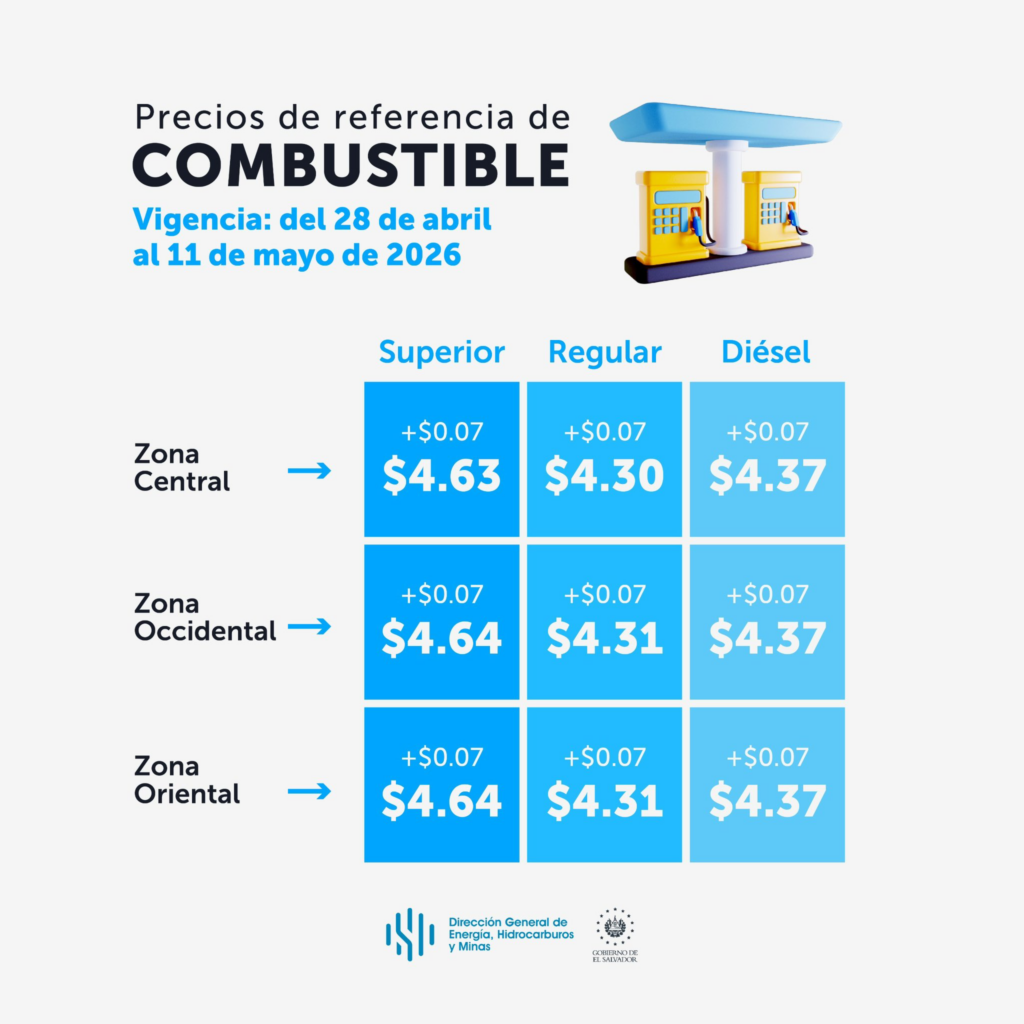
The reference prices of fuels in El Salvador will register an increase of US$0.07 per gallon in premium gasoline, regular and diesel at national level, according to information from the Dirección General de Energía, Hidrocarburos y Minas. The adjustment will come into effect on march 28th and will remain in effect until may 11th, 2026, impacting the three zones of the country equally.
In the central zone, premium gasoline will cost US$4.63 per gallon, while regular gasoline will reach US$4.30 and diesel will rise to US$4.37. This increase represents a new adjustment to the price of fuel, which could have a direct impact on the daily expenditure of drivers, motorcyclists and production sectors that depend on transport.
For the western zone, prices will fall to US$4.64 for premium gasoline, US$4.31 for regular and US$4.37 for diesel. However, the eastern zone will maintain the same values: US$4.64 for the superior, US$4.31 for the regular and US$4.37 for diesel, thus consolidating a uniform increase of seven cents throughout the national territory.
The institution explained that this new increase responds mainly to international factors that continue to generate pressure on the hydrocarbon market. One of the main elements is the geopolitical tension in the Strait of Hormuz, one of the most important routes for world oil trade, a situation that has increased the risk and, ultimately, international prices.
This adds to the threats to commercial navigation in the Red Sea and the Strait of Bab el-Mandeb, where actions attributed to human groups in Yemen have increased the uncertainty in the maritime transit of crude and derivatives. This situation has maintained an upward trend in global energy markets.
Another factor that influences the increase, as detailed by the International Energy Agency, is the sustained decrease in gasoline and diesel reserves in the United States, which generates greater tension in available supply and pressures reference prices at an international level.

The DGEHM remembers that these amounts include taxes from current laws, as well as contributions such as COTRANS and FEFE. Furthermore, it ensured that inspection operations were maintained at service stations to verify that the population received the exact quantity of fuel for what it paid for and that the technical quality specifications were met.
With this new adjustment, the price of fuels will rise to high levels, especially for gasoline, which in some areas exceeds US$4.60 per gallon, a behavior that could have repercussions on the cost of transportation and other services linked to the consumption of hydrocarbons.
You can also read: