

 dinero_admin
The construction and commerce sectors emerged as the main drivers of business credit growth in El Salvador as of the end of april 2026, according to data from the Banco Central de Reserva (BCR), reflecting increased economic momentum and growing investment in productive activities.
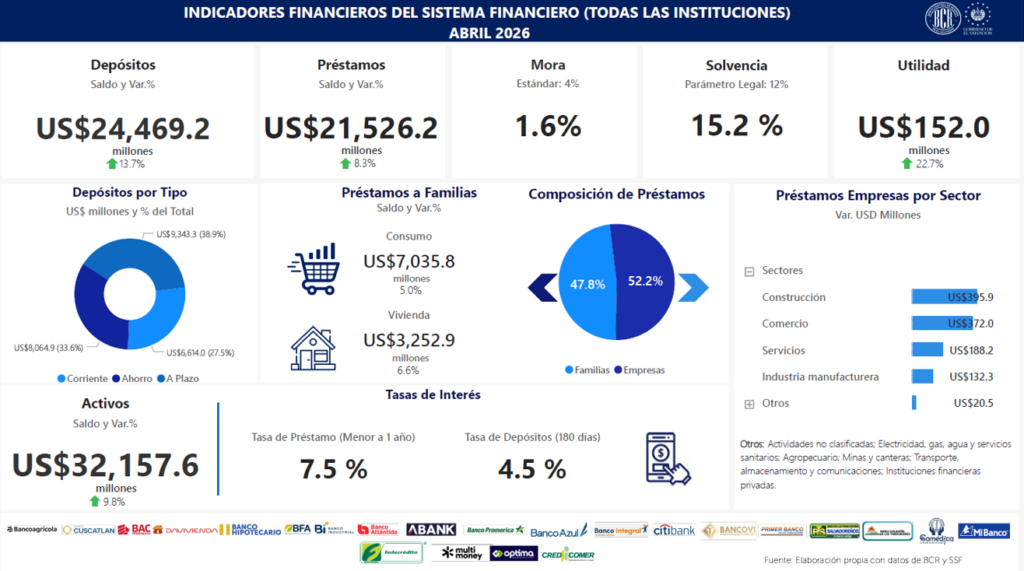
According to the report, construction recorded the largest increase in business financing, with a rise of US$395.9 million compared to the same period last year. It was followed by the trade sector, which reported growth of US$372 million, while services increased by US$188.2 million and manufacturing by US$132.3 million.
The performance of these sectors demonstrates increased demand for resources to expand operations, develop projects, strengthen supply chains, and support the growth of economic activity in the country.
Loan porfolio continues to grow
The growth in business financing is part of a broader expansion of credit within the salvadoran financial system. As of the end of april 2026, the total loan portfolio reached US$21,526.2 million, marking year-over-year growth of 8.3%.
Of the total loans granted, 52.2% went to businesses, while 47.8% went to households, showing a balanced distribution between productive financing and household consumption.
In the household segment, consumer loans reached US$7,035.8 million, with annual growth of 5%, while housing loans totaled US$3,252.9 million, registering an increase of 6.6%.

Deposits reflect confidence in the financial system
The report also highlights that credit growth has been supported by greater availability of funds within the financial system. Deposits reached US$24,469.2 million, reflecting year-over-year growth of 13.7%.
This increase in deposits demonstrates the confidence of individuals and businesses in financial institutions and strengthens banks’ ability to continue providing financing to various sectors of the economy.
Indicators show financial stability
In terms of financial stability, indicators continue to show favorable results. The delinquency rate stood at 1.6%, well below the prudential threshold of 4%, while the capital adequacy ratio reached 15.2%, far exceeding the legal minimum of 12%.
These results reflect the sound quality of the loan portfolio and the financial institutions’ strong ability to meet their obligations and address potential risks.
Profits continue to rise
Meanwhile, the financial system’s profits reached US$152 million at the end of april, with year-over-year growth of 22.7%, while total assets amounted to US$32,157.6 million, marking an expansion of 9.8%.
According to the Banco Central de Reserva, the performance observed in the main indicators confirms that the salvadoran financial system maintains adequate levels of liquidity, solvency, and profitability, allowing it to continue supporting investment, consumption, and the country’s economic growth.
You may also read: