

 dinero_admin
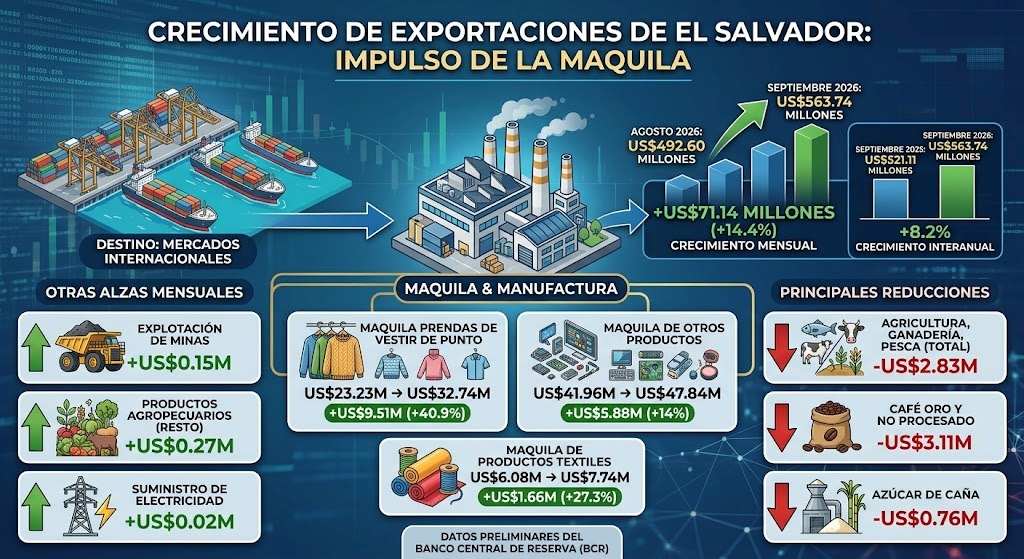
El Salvador’s exports totaled US$563.74 million in september 2026, an increase of US$71.14 million (14.4%) compared to august, when they reached US$492.60 million. This growth was driven primarily by the manufacturing and maquilaindustries, according to preliminary figures from the Banco Central de Reserva (BCR).
Maquila sector fuels monthly growth
Exports from the maquila manufacturing industry rose from US$71.26 million in august to US$88.33 million in september, an increase of US$17.07 million, or 24%. Within this sector, the assembly of knitted garments grew by US$9.51 million (40.9%), rising from US$23.23 million to US$32.74 million.
Exports of other maquila products also increased, rising by US$5.88 million (14%) to reach US$47.84 million, while textile product exports grew by US$1.66 million (27.3%), climbing from US$6.08 million to US$7.74 million. Overall, the manufacturing industries saw their foreign sales increase by US$57.27 million (14.1%), rising from US$406.88 million to US$464.15 million.
Some sectors saw gains, while others experienced declines
Among other categories that posted monthly increases, the mining and quarrying sector stood out; its exports rose from US$0.07 million to US$0.22 million,an increase of US$0.15 million (214.3%). Other agricultural and livestock products grew by US$0.27 million (7%) to reach US$4.12 million, while the supply of electricity, gas, steam, and air conditioning increased by US$0.02 million (1.8%) to reach US$1.14 million. Processed coffee remained steady at US$0.13 million.
In contrast, exports from agriculture, livestock, forestry, and fishing decreased by US$2.83 million (23.2%), falling from US$12.22 million in August to US$9.39 million in September. Within this category, green coffee and other unprocessed coffees dropped by US$3.11 million (37.1%) to US$5.27 million. Cane sugar and other sugars fell by US$0.76 million (18.6%) to US$3.33 million, while wholesale and retail trade and vehicle repair declined by US$0.52 million (50%) to US$0.52 million.
Exports grew by 8.2% over the year
Comparing september 2026 with the same month in 2025, total exports increased by US$42.63 million (8.2%), rising from the US$521.11 million recorded a year earlier to US$563.74 million. During this period, the maquila industry grew by US$12.29 million (16.2%), increasing from US$76.04 million to US$88.33 million.
The maquila of other products saw an increase of US$13.28 million (38.4%), reaching US$47.84 million, while the maquila of textile products rose by US$3.78 million (95.5%), growing from US$3.96 million to US$7.74 million. Conversely, the maquila of knitted apparel declined by US$4.78 million (12.7%), falling from US$37.52 million to US$32.74 million.
Manufacturing grew, but sugar and coffee declined
Manufacturing industries, taken together, increased their exports by US$33.46 million (7.8%), rising from US$430.69 million in september 2025 to US$464.15 million in september 2026. Other manufactured products excluding sugar and processed coffee grew by US$38.78 million (9.2%), reaching US$460.68 million.
Among the primary year-over-year declines, cane sugar and other sugars stood out, decreasing by US$5.38 million (61.8%), from US$8.71 million to US$3.33 million. Green coffee and other unprocessed coffees fell by US$2.38 million (31.1%) to US$5.27 million, while the agriculture, livestock, forestry, and fishing sector declined by US$1.57 million (14.3%) to US$9.39 million. The supply of electricity, gas, steam, and air conditioning also saw a 54% drop, while wholesale and retail trade, along with vehicle repair, fell by 40.2%.
According to preliminary data from the BCR, salvadoran exports recorded both monthly and year-on-year increases in September 2026. The maquila sector and other manufacturing industries were key drivers of this growth, whereas sugar, unprocessed coffee, and other agricultural products experienced declines.
You may also want to read: