

 dinero_admin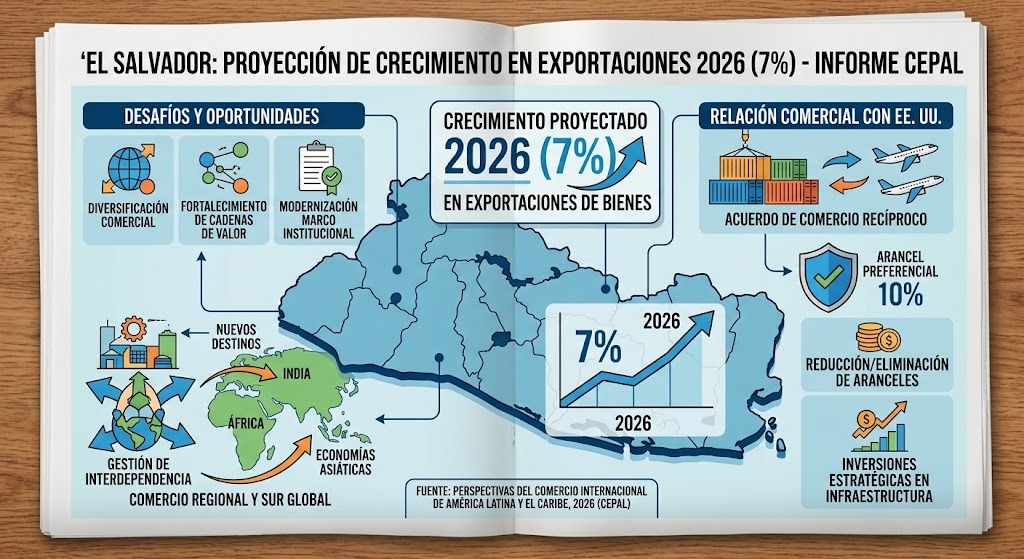
El Salvador projects a 7% increase in the value of its goods exports by 2026, according to the report International Trade Outlook for Latin America and the Caribbean, 2026: The Importance of Modern Services Exports and How to Promote Them, presented by the Economic Commission for Latin America and the Caribbean (ECLAC). These projections open opportunities for the country to expand its participation in international markets, diversify its trade relations, and strengthen its productive activity.
The trade landscape offers opportunities for the salvadoran economy, particularly by allowing it to capitalize on international demand for resources, products, and services. In this context, trade and investment remain key drivers of economic growth, both for El Salvador and for the rest of Latin America and the Caribbean.
A significant factor for the country is its trade relationship with the United States. According to the information provided, El Salvador entered into a reciprocal trade agreement that includes commitments to reduce or eliminate tariffs on U.S. imports, strengthen intellectual property protection, and facilitate strategic investments in infrastructure.
This agreement is one of the factors that can influence trade between the two nations. The reduction or elimination of certain tariffs, combined with measures to facilitate investment, can create opportunities for companies engaged in bilateral trade and for productive activities linked to international markets.
Regarding tariffs, the information indicates that El Salvador secured a preferential tariff rate of 10% within the framework of U.S. trade reviews, avoiding the higher levies applied to other trade partners under investigation. This status is a significant element for the Salvadoran business environment, as it defines some of the conditions under which its products can access that market. Another challenge and opportunity for the country lies in diversifying its trade relations and strengthening its participation in global value chains. To this end, it is crucial to continue modernizing the trade and institutional framework and to develop productive capacities that enable Salvadoran companies to meet the needs of various markets.
Diversification also entails identifying new export destinations and expanding economic ties beyond traditional partners. In this regard, ECLAC Executive Secretary José Manuel Salazar-Xirinachs maintained that countries in the region must learn to manage economic interdependence through partnerships, diversification, productive development policies, and the pursuit of opportunities in markets such as India, Africa, and other Asian economies. He also highlighted the importance of rethinking regional trade and boosting exchanges among Global South nations.
Within the Latin American context, trade outlooks vary across countries and sectors. Peru and Mexico stand out for their export dynamism, driven by metals and manufactured goods, while Central America maintains growth described as stable and resilient. For El Salvador, this scenario reinforces the importance of seizing trade opportunities and consolidating its export performance.
The projected 7% growth in goods exports by 2026 represents an opportunity to strengthen salvadoran economic activity and expand the presence of its products abroad. Capitalizing on this potential will depend on the ability of companies and the country to diversify markets, improve their integration into trade networks, and translate international opportunities into increased productive activity and investment.
You may also read: