

 dinero_admin
The development of a new port-based logistics platform on the Guatemalan Atlantic coast aims to engage the salvadoran business community and investors. Featuring designated spaces for industry, warehousing, and services related to international trade, the Centro Logístico Internacional San Jorge (CLI San Jorge) will showcase its business opportunities on november 13 in San Salvador. This presentation will also highlight COINGT, a digital asset that enables participation in the current phase of the Interoceanic Corridor of Guatemala and El Salvador.
The proposal offers two key opportunities for local businesses: establishing a presence at a new port, operating under a free-trade zone regime on the Guatemalan Atlantic coast, to expand operations; and participating as investment partners in the Interoceanic Corridor through the COINGT digital asset, which is regulated under salvadoran law. While CLI San Jorge provides the logistics and industrial infrastructure, COINGT offers a pathway to share in the future revenue streams of the issuing entity, in accordance with El Salvador’s Digital Asset Issuance Law. Both topics will be the focus of the upcoming event in the salvadoran capital.
“We invite the salvadoran business community to view CLI San Jorge as a gateway to expand their operations toward the Atlantic. We also encourage them to see COINGT as a unique, once-in-a-generation opportunity to form a lasting partnership with our company, contributing their industrial capacity, export expertise, and services to the development of infrastructure that will connect two oceans and serve global trade”, said Guillermo Catalán, President of the Consorcio Interoceánico de Guatemala S. A. (CIGSA).
Business associations are also participating in this event. The Asociación Salvadoreña de Industriales (ASI), Cámara de Comercio e Industria de El Salvador (CAMARASAL) and Corporación de Exportadores de El Salvador (COEXPORT) invite their members and the business community at large to attend this event, which they consider to be of great significance for the economic future of Central America’s Northern Triangle.
The gathering will feature the participation of the founders and promoters of this megaproject, foreign and local business leaders involved in the initiative, representatives from regional academic institutions, and public officials who are driving investment, infrastructure, and economic integration in Central America.
CLI San Jorge: An opportunity on the guatemalan caribbean
Located across a 21-square-kilometer area in the municipality of Puerto Barrios, on Guatemala’s Atlantic coast, CLI San Jorge serves as the initial economic component of the Interoceanic Corridor of Guatemala and El Salvador. Its design includes deep-water port terminals, a cruise ship terminal, a cargo airport, industrial parks, warehouses, commercial areas, and service facilities, all operating under a free-trade zone regime. Through this infrastructure, the developers aim to attract salvadoran companies looking to expand their production and logistics operations in a municipality that has long served as a vital hub for Guatemala’s foreign trade.
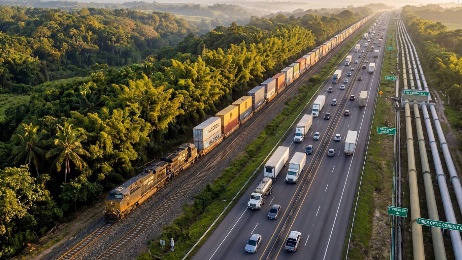
CLI San Jorge is part of the Interoceanic Corridor of Guatemala and El Salvador, a private-sector initiative that has secured a 372-kilometer-long, 140-meter-wide strip of land across Guatemala. This corridor connects the country’s Atlantic and Pacific coasts, with a planned extension reaching the border with El Salvador. The corridor integrates ports with freight rail, highways, and energy infrastructure, alongside industrial zones and logistics centers.
The developers envision this infrastructure project as a complementary alternative to other global trade routes, such as the Panama Canal, offering opportunities for Central American economies to integrate and connect.
COINGT: A Regulated investment alternative in El Salvador
The agenda addresses a key question: how can investment capital be linked to the development of the interoceanic corridor? This is the purpose of COINGT a digital asset regulated under salvadoran law. It provides access to the economic rights held by its issuer, GODES, S. A. de C. V. which stem from a specific equity stake in CIGSA, the company that owns the project. “COINGT offers investors from around the world the opportunity to invest in large-scale infrastructure. Leveraging El Salvador’s Digital Asset Issuance Law, we present an opportunity to gain a stake in a venture comparable to the Panama Canal or the Suez Canal, one that benefits from legal protections and tax incentives, and provides a pathway for more investors to share in the future revenue flows generated by the development of this corridor”, explains Julio Sibrián, director of CIGSA and CEO of GODES.
This regulated financial instrument for capital raising seeks to broaden the participation of individual and institutional investors from around the world. According to the documentation for the public offering, authorized by Comisión Nacional de Activos Digitales de El Salvador (CNAD), the funds raised are earmarked for land titling and consolidation, as well as for advancing toward the construction phase, among other purposes detailed in the documentation. COINGT investors will receive a pro-rata share of the economic benefits generated by the Interoceanic Corridor, in accordance with the terms of the offering.
“We want the business community to understand both opportunities: developing businesses within CLI San Jorge and participating in our company through COINGT. Each path has a different scope, and this meeting will provide an opportunity to explain how they relate to the project”, explains Sibrián.
The Interoceanic Corridor is built upon its Integrated Strategic Territorial Platform, which incorporates Guatemalan families, who have contributed their land as partners across six departments in the eastern part of the country, as well as organized communities and local leadership. According to its promoters, this structure is the result of work carried out over more than two decades.
You may also want to read: