

 dinero_admin
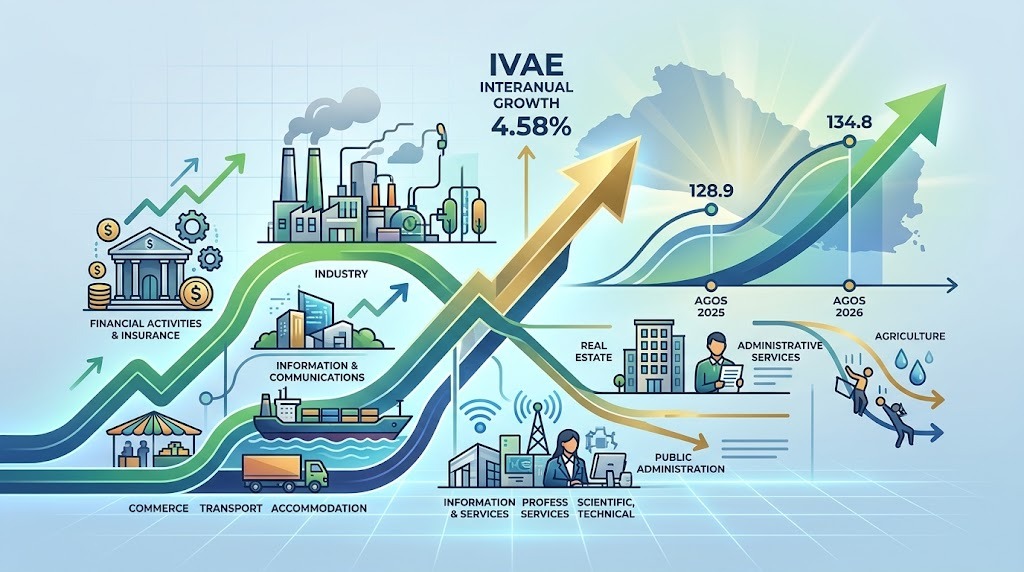
Economic activity in El Salvador recorded a monthly growth of 0.15% in august 2026, according to the seasonally adjusted Índice de Volumen de la Actividad Económica (IVAE) from the Banco Central de Reserva (BCR). The indicator rose from 134.6 points in july to 134.8 points in august, representing an increase of 0.2 points over the month.
When compared to august 2025, the growth was more significant. The IVAE rose from 128.9 points to 134.8 points, an increase of 5.9 points, reflecting a year-on-year growth rate of 4.58%. These results indicate a higher volume of economic activity compared to the same month of the previous year.
In the month-on-month comparison, the sector with the strongest growth was financial and insurance activities, with its indicator rising from 175.2 points in july to 177.5 in august. This represents an increase of 2.3 points, equivalent to 1.31% growth. In second place was the industrial sector, measured by Índice de Producción Industrial (IPI), which encompasses manufacturing, mining, and other industrial activities, which advanced from 113.2 to 114.3 points, an increase of 1.1 points or 0.97%.
The combined category of commerce, transport, storage, accommodation, and food services also posted a positive result, with its index rising from 138.3 to 139.2 points. This 0.9-point difference equates to a monthly growth rate of 0.65%. These three sectors were the ones that showed gains in august compared to the previous month.
Meanwhile, two other activities saw their indicators remain unchanged. Real estate activities remained at 121.2 points, while professional, scientific, technical, and support services held steady at the 150 points recorded in july. In both cases, the monthly growth rate was 0.00%.
In contrast, four sectors experienced declines. Construction fell from 204.5 to 204.3 points, equivalent to a 0.10% decrease; agriculture, livestock, forestry, and fishing activities dropped from 101.2 to 100.7 points, a decline of 0.49%. Also included in this group were information and communications, which fell by 1.03%fr om 145.1 to 143.6 points and public administration, defense, education, health, and social assistance, whose indicator decreased by 1.37%, from 124.4 to 122.7 points. This latter group saw the largest monthly contraction.
In a year-over-year comparison looking at august 2026 versus the same month in 2025, the sector with the highest growth was public administration, defense, education, health, and social assistance, which rose by 7.54%, moving from 114.1 to 122.7 points. This was followed by construction, which grew by 6.74%, increasing from 191.4 to 204.3 points. Real estate activities also performed notably, with an increase of 5.39%, while the industrial sector grew by 4.57% and financial and insurance activities advanced by 4.17%.
Other sectors that recorded year-over-year increases included information and communications, with 4.44%, and trade, transportation, warehousing, accommodation, and food services, with 4.27% and professional, scientific, technical, and support services, at 1.35%. In contrast, the agriculture, livestock, forestry, and fishing sector were the only one to show a negative change in this comparison, with a 0.79% decline dropping from 101.5 points in august 2025 to 100.7 points in august 2026.
The BCR reported that the figures for august 2026 are estimates, and that data up to june of that year have been revised; the figures also incorporate an alignment with the second quarter of 2026. Consequently, the indicator showed a moderate monthly gain while maintaining a year-on-year growth rate of 4.58%, with positive results across most economic activities.
You may also want to read: