

 A. M.
A. M. 
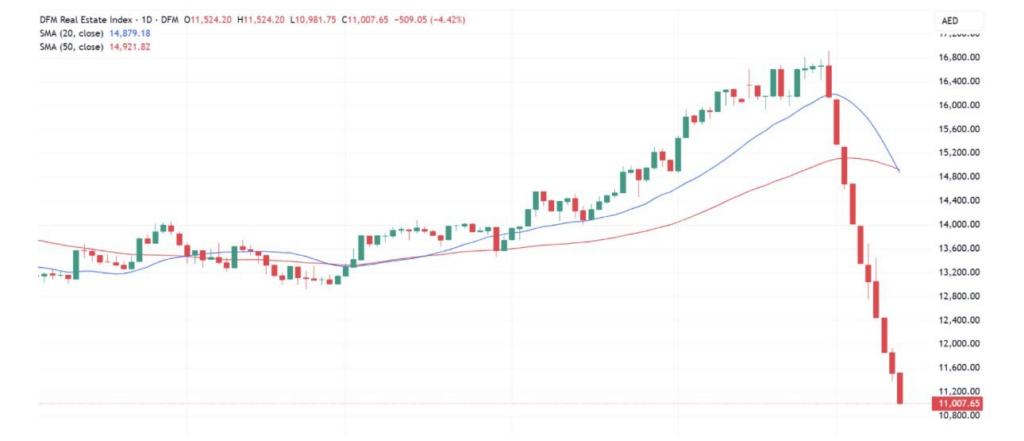
The Dubai real estate market is going through one of its most critical moments in years, after registering a cumulative drop of close to 60% in its sectoral index, reflecting a sharp change in trend after a period of strong growth.
The fall occurs after the real estate index reached levels close to 16,700 points and quickly fell to around 11,000, as observed in recent market data, evidence a strong liquidation of assets and loss of investor confidence.
From accelerated boom to abrupt collapse
The adjustment is even more significant if we consider that the sector was experiencing sustained growth. Between 2022 and early 2025, property prices in Dubai had risen around 60%, driven by foreign investment, tax benefits and high demand.
However, this accelerated growth also generated risks of overvaluation. In a matter of days, the market erased much of its recent gains, with initial declines of more than 20% following geopolitical events that triggered selloffs.
A market with excess supply
One of the factors that aggravates the situation is the volume of projects in development. Currently, there is approximately $120 billion in construction pending delivery, which represents significant pressure on prices in the short and medium term.
Added to this is that in the last five years, properties worth close to a trillion dollars have been delivered, which shows the magnitude of the recent real estate boom and the risk of market saturation.
This excess supply, combined with the departure of investors, is generating an imbalance between supply and demand that accelerates the fall in prices.
Risks for the financial system
The impact is not limited to the real estate sector. The banks that financed this growth now face a complex scenario, faced with the possibility of an increase in loan defaults linked to real estate projects.
The decline in asset values reduces loan collateral, increasing the exposure of the financial system and raising the risk of a chain of defaults.
In addition, corporate bonds linked to the real estate sector have been among the hardest hits in emerging markets, reflecting the loss of investor confidence.
External factors aggravate the crisis
The international context has also played a key role. Tensions in the Middle East have weakened confidence in the region, causing capital outflows, a drop-in economic activity and a brake on new investments.
Even key sectors such as tourism and financial services have shown signs of contraction, directly affecting real estate demand in the city.
Correction or start of a major crisis?
Although some analysts consider this to be a correction after years of accelerated growth, the magnitude of the drop (close to 60%) and the volume of projects in progress raise doubts about the stability of the market in the short term.
The precedent of the real estate crisis of 2009, when prices also suffered sharp falls due to excess supply and debt, once again raises alarm bells about the sustainability of the model.
Perspectives
The future of Dubai’s real estate market will depend on several factors, including the evolution of the geopolitical context, the ability to absorb existing supply and the stability of the financial system.
For now, the collapse of the index reflects a sharp change in the emirate’s economic cycle, going from a boom driven by global investment to a scenario marked by uncertainty, deep corrections and growing financial risks.
You can also read: