

 dinero_admin
The Banco Central de Reserva de El Salvador (BCR) has launched a financial education initiative aimed at improving money management in Salvadoran households, with a practical approach: demonstrating that saving doesn’t always depend on large incomes, but rather on small changes in daily spending habits.
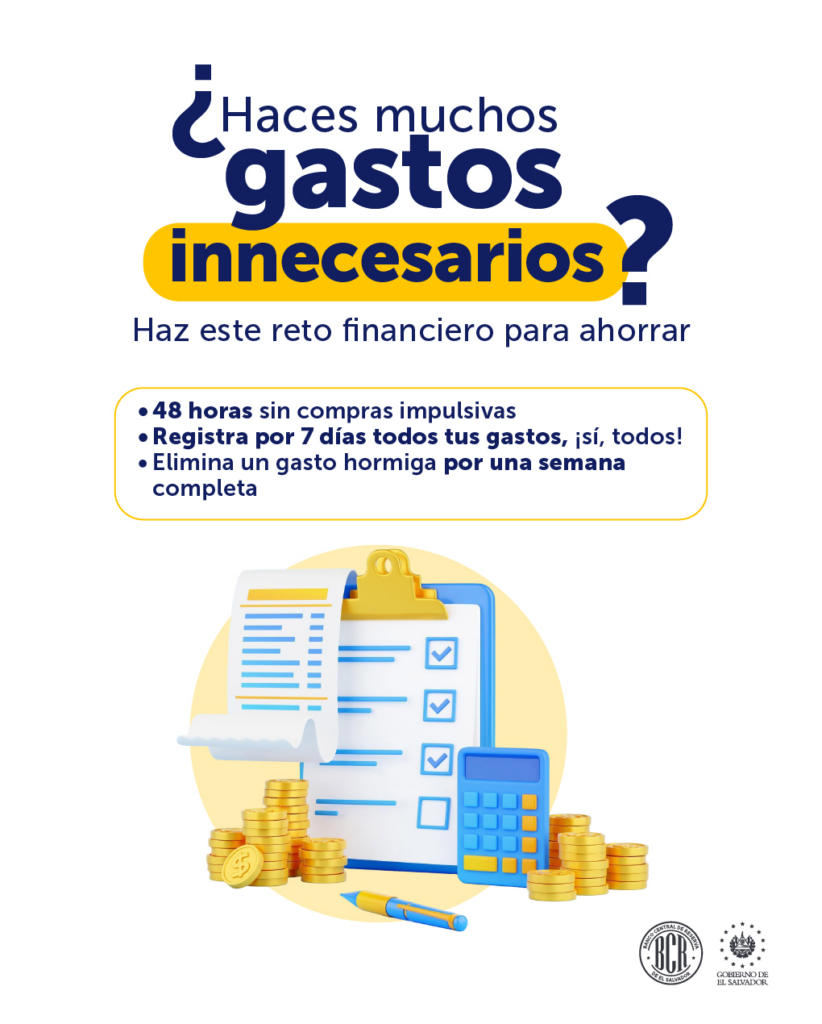
The initiative invites people to take part in a seven-day challenge in which they record all their expenses, without exception, with the goal of becoming more aware of how money is used and identifying unnecessary spending patterns.
A simple challenge to understand daily spending
The challenge begins with a key recommendation: for 48 hours, avoid impulse purchases. This first step aims to help identify which expenses are truly necessary and which are driven by momentary or emotional decisions.
Then, for a full week, participants must record absolutely all their expenses, from the largest to the smallest. The goal is to highlight what are commonly known as “small, everyday expenses”—those seemingly insignificant outlays that, when added together, represent a significant portion of a person’s budget.
The value of observing before spending
According to the BCR’s approach, the exercise focuses not only on stopping spending but also on observing and understanding how money is allocated. At the end of the seven days, participants can identify how much money they could have saved simply by reducing unnecessary purchases or postponing spending decisions.
This method aims to have a direct impact on financial literacy, promoting the discipline of recording and reflecting before spending.
From awareness to real savings
The bank emphasizes that one of the main benefits of the challenge is that it allows for transforming daily habits without resorting to extreme measures. The key is consistency: by recording each expense, users gain a clearer view of their financial behavior and can make more informed decisions in the future.
Furthermore, exercise allows you to identify savings opportunities that often go unnoticed in your daily routine, such as repetitive purchases, unnecessary consumption, or frequent small expenses.

Financial education as a tool for change
These types of initiatives are part of the efforts to strengthen a savings culture in the country, especially in a context where responsible personal finance management is fundamental to household economic stability.
The Banco Central de Reserva de El Salvador (BCR) emphasizes that saving depends not only on income level but also on the ability to plan and control spending. With this challenge, it seeks to encourage greater financial awareness and motivate the population to adopt healthier money management habits.
At the end of the week, the message is clear: every consumption decision counts, and small adjustments can generate significant results in your personal finances.
You can also read: