


 dinero_admin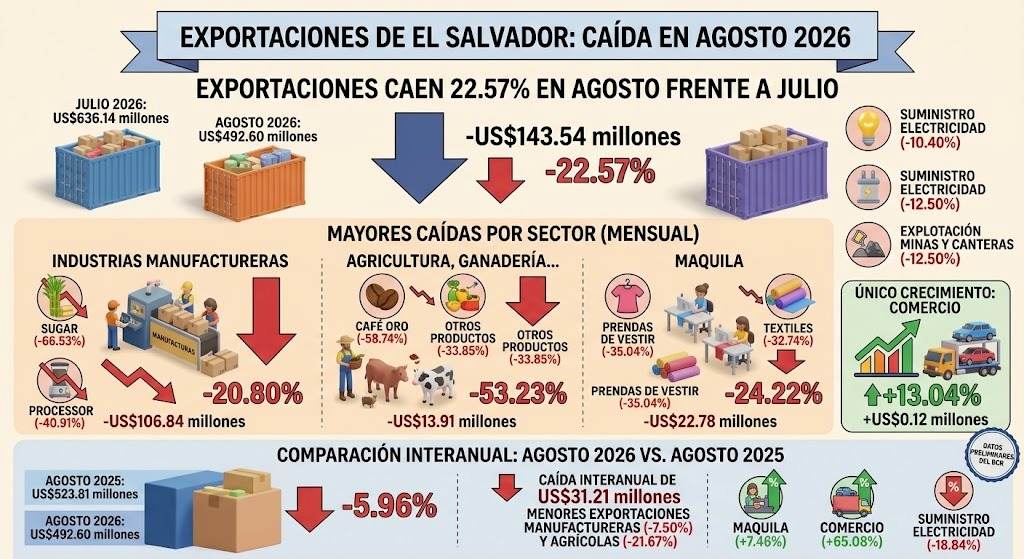
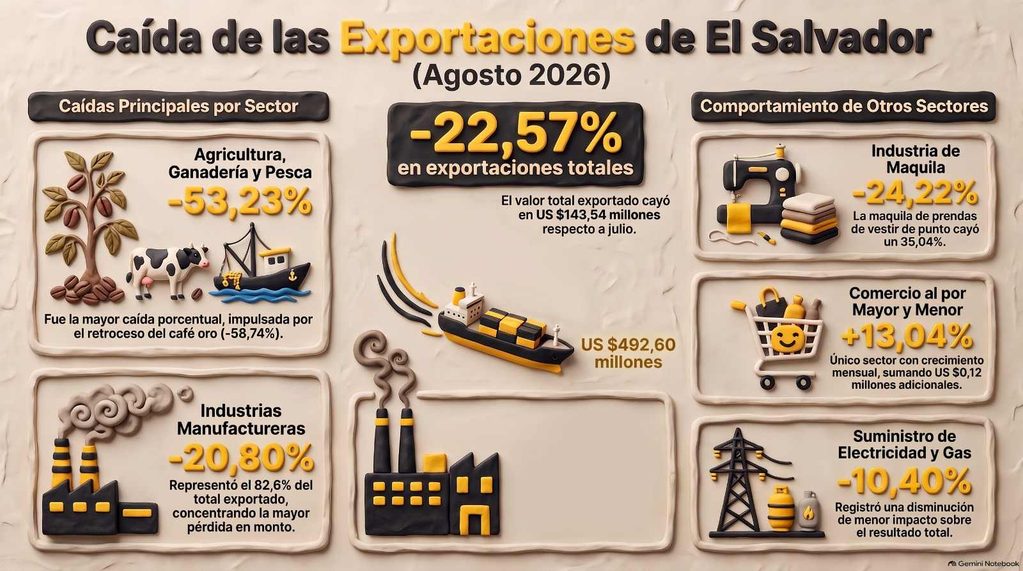
El Salvador’s exports totaled US$492.60 million in august 2026, a decrease of US$143.54 million—equivalent to 22.57%—compared to the US$636.14 million recorded in July. The preliminary data were provided by the Banco Central de Reserva (BCR), through the External Sector Department, using information from the General Directorate of Customs and fuel distributors, in accordance with Balance of Payments methodology.
The sharpest decline was seen in the manufacturing sector, where exports fell from US$513.72 million in july to US$406.88 million in august. This represented a decrease of US$106.84 million, equivalent to 20.80%. This sector accounted for approximately 82.6% of total exports in august, thus accounting for the bulk of the monthly decline. Among its main categories, other manufactured goods decreased by 19.68%, while cane sugar and other sugars fell by 66.53% and processed coffee dropped by 40.91%.
The second-largest decline in value was recorded in agriculture, livestock, forestry, and fishing, where exports fell from US$26.13 million to US$12.22 million, a decrease of US$13.91 million, equivalent to 53.23%. This trend was driven primarily by green coffee and other unprocessed coffee, whose exports fell by 58.74%, from US$20.31 million to US$8.38 million. Exports of other agricultural products also declined by 33.85%.
The maquila manufacturing industry ranked third among the sectors with the largest declines. Its exports fell from US$94.04 million in july to US$71.26 million in august, a decrease of US$22.78 million, equivalent to 24.22%. By category, knitwear maquila exports decreased by 35.04%, textile maquila exports fell by 32.74%, and maquila exports of other products declined by 14.79%.

Two other sectors also recorded declines, although with a much smaller impact on the overall result. The supply of electricity, gas, steam, and air conditioning fell from US$1.25 million to US$1.12 million, a drop of 10.40%. Meanwhile, mining and quarrying fell from US$0.08 million to US$0.07 million, a decrease of 12.50%. Due to the small volume of its exports, this sector had a minimal impact on the overall result.
In contrast, the wholesale and retail trade and repair of motor vehicles and motorcycles was the only sector to post growth between july and august. Its exports rose from US$0.92 million to US$1.04 million, representing an increase of US$0.12 million, or 13.04%. Thus, of the six sectors reported, five showed declines and one showed growth during the period.
In percentage terms, agriculture, livestock, forestry, and fishing recorded the largest decline, at 53.23%, followed by the maquila manufacturing industry, at 24.22%, and other manufacturing industries, at 20.80%. The declines were smaller in mining and quarrying (-12.50%) and electricity, gas, steam, and air conditioning supply (-10.40%), while trade was the only sector to show an increase, at 13.04%.
When comparing uagust 2026 to the same month in 2025, exports also show a decline. In august 2025, they totaled US$523.81 million, compared to US$492.60 million in ugaust 2026a , of US$31.21 million, equivalent to 5.96%. The manufacturing sector was once again the main factor behind the decline, falling from US$439.84 million to US$406.88 million—a drop of US$32.96 million, equivalent to 7.50%.
Agriculture, livestock, forestry, and fishing also declined year-over-year, falling from US$15.60 million to US$12.22 million—a 21.67% decrease. In contrast, maquila exports increased by 7.46%, from US$66.31 million to US$71.26 million, while trade grew by 65.08%, from US$0.63 million to US$1.04 million. Electricity supply fell by 18.84%, while mining and quarrying increased by 75.00%, albeit from a very low base.
Overall, BCR data show that Salvadoran exports declined in both the month-over-month and year-over-year comparisons. Between july and august 2026, the decline was 22.57%, mainly due to decreases in manufacturing, maquila, and agriculture; while compared to august 2025, the decline was 5.96%, with lower manufacturing and agricultural exports, partially offset by growth in maquila and trade.
You can also read: