

 dinero_admin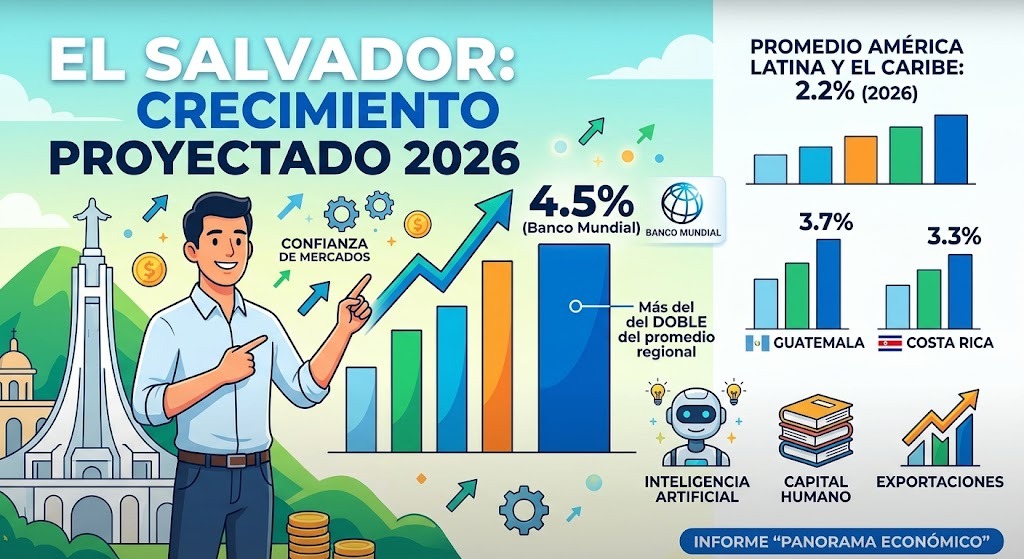
The World Bank projects that El Salvador’s economy will grow by 4.5% in 2026, one of the highest rates in Latin America, according to the *Latin America and the Caribbean Economic Outlook report. This estimate places the country among the region’s top-performing economies, even amidst an international landscape marked by economic and financial challenges.
The international institution estimates that Latin America and the Caribbean will grow by 2.2% in 2026, a figure that, according to the report, reflects the constraints facing the region’s economies and falls short of their true potential. Factors limiting growth include persistent inflation, limited fiscal space, and high borrowing costs.
Against this backdrop, El Salvador stands out with a projected growth rate of 4.5% for 2026, more than double the estimated regional average. This figure represents a World Bank estimate and highlights a significant difference compared to the average for Latin America and the Caribbean.
The projection also places El Salvador among the countries with the highest growth rates in the World Bank’s data. Guatemala is estimated at 3.7%, while Costa Rica is at 3.3%. The Bahamas and Dominica appear with 3.0%, and Argentina and Brazil with 2.1% each. In contrast, Bolivia faces a projected contraction of 2.8%.
Guyana’s projected growth is substantially higher than that of the other countries listed, reaching 23.7% for 2026, driven by the unique nature of its economic expansion. Even excluding this outlier, El Salvador remains among the economies with the highest projected growth rates on the list. For 2027, the World Bank projects that El Salvador will maintain a growth rate, albeit lower than the rate forecast for 2026, at 3.9%. Guatemala is projected at 3.8%, Costa Rica at 3.5%, Argentina and Chile at 3.0%, and Colombia at 2.6%.
The report notes that the differences between countries stem, among other factors, from the quality and durability of public policy decisions. According to the institution, countries that have adopted robust, long-lasting measures are achieving better results in terms of growth, investment, and market confidence.
The World Bank also highlights that the region is benefiting from resilient export volumes and new trade agreements, although these opportunities are being offset by uncertainty regarding both external and internal policies. Compounding these are structural issues such as labor informality, human capital deficits, and climate-related vulnerabilities.
In its analysis, the institution also identifies artificial intelligence as a potential catalyst for economic development. The report suggests that Latin America and the Caribbean can leverage specific, simple, and low-cost AI tools to solve concrete problems, without necessarily needing to resort to the most expensive and advanced models.
The report warns that harnessing artificial intelligence to boost productivity requires building capabilities, improving data, training workers, and strengthening public services. It also suggests that governments can play a significant role as users of new technologies and as drivers of workforce retraining.
The 4.5% growth projection for El Salvador in 2026 was highlighted by President Nayib Bukele in a post on X, in which he noted that the country would be the third-fastest-growing economy in Latin America, or the fourth when including the Caribbean. By 2027, the World Bank forecasts that growth in El Salvador will moderate to 3.9%, though it would remain above the regional average projected for 2026.
You may also want to read: