

 dinero_admin
Labor Minister Rolando Castro announced at a press conference that the institution has stepped up nighttime inspections to verify the working conditions of these employees.
“Close to 20% of the workforce in El Salvador works night shifts. That is a significant number of employees who deserve the same protection and guarantees regarding their rights”, Castro noted.
The official explained that the Ministry modified its traditional inspection model to implement rotating shifts, ensuring that inspectors are also present at night.
“We decided to move away from the traditional inspection model and establish rotating shifts so that our inspectors are present at night as well, verifying working conditions”, he said.
Non-compliance regarding overtime and night-shift pay detected
Castro indicated that inspections have uncovered cases where the required payments for overtime and the 25% night-shift premium were not being made.
“The law doesn’t keep office hours. That is why our labor inspection teams also work at night”, the minister said.
He also pointed out that irregularities regarding enrollment and deductions for the ISSS and AFPs had been identified, issues that, he explained, affect workers’ access to social security.
The Ministry assured that these checks would not be limited to one-off operations; instead, inspectors will maintain a permanent presence during night shifts.

Tips and tourism sector workers
Another issue addressed by the minister was the handling of tips in establishments such as restaurants and hotels.
Castro stated that instances had been identified where tips were not being passed on to the workers. He explained that, in some cases, these funds are used to cover other expenses, such as hiring staff. The official noted that gratuities are covered under labor laws, so the Ministry will also verify compliance in this regard.
Modernization of work schedules remains under discussion
Regarding the proposal to modernize work schedules, Castro stated that the matter is still being discussed and various alternatives are being analyzed.
One of the proposals to gain significant traction, according to the minister, is making the implementation of new scheduling schemes optional, although a final decision has not yet been reached.
Castro emphasized that any modification must be analyzed from a technical standpoint and without infringing upon workers’ acquired rights.
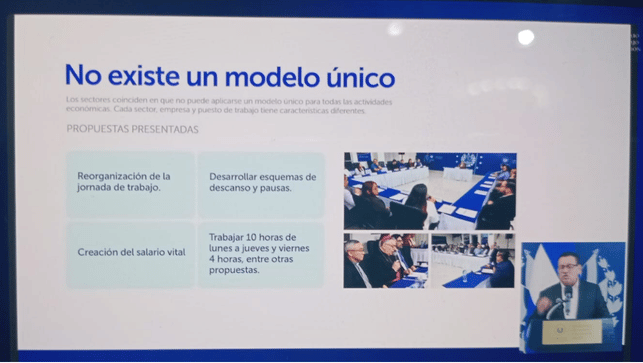
“The discussion on modernizing work schedules does not put at risk rest periods, leave, overtime pay, or any other acquired rights of workers”, he assured.
He also indicated that the specific circumstances of working mothers and individuals who study after their workday must be considered.
“The discussion regarding the modernization of work schedules must be strictly technical, analyzing all variables before any decision is made”, he said.
Staggered schedules are among the alternatives being analyzed, with the aim of meeting the needs of both the labor market and businesses.
Year-end bonuses may be paid starting october 1
The conference also addressed the timeframe for the early payment of year-end bonuses. Companies may begin making these payments as early as October 1 but must complete the process no later than december 20, according to the details provided.
The minister also noted that under a hypothetical schedule, such as 11 days of work followed by four days of rest, if a worker were required to work an additional day beyond the set schedule, that time would have to be compensated accordingly, including double pay where applicable.
Castro maintained that the modernization of schedules must address the new needs of the domestic market without shifting the costs of these changes onto workers’ labor rights.