

 dinero_admin
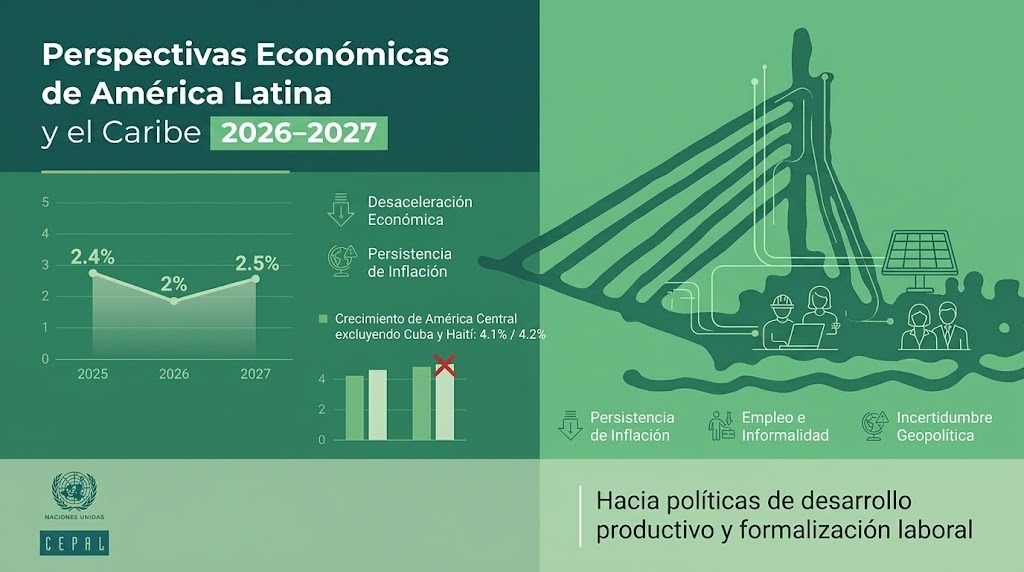
The economy of Latin America and the Caribbean is projected to grow by 2% in 2026 and 2.5% in 2027, according to forecasts by the Economic Commission for Latin America and the Caribbean (ECLAC). These estimates reflect a slowdown from the 2.4% growth recorded in 2025, followed by a moderate recovery the following year, amid international uncertainty and various factors that could constrain regional economic performance.
According to the organization, the outlook is shaped by geopolitical tensions, disruptions to logistics routes, and uncertainty regarding trade policies. These factors could affect exports, drive up the cost of imports, and increase production costs, particularly due to fluctuations in energy and food prices.
Employment, inflation, and financing influence growth
ECLAC notes that the impact of these conditions varies from country to country. While economies that export raw materials may benefit from higher international prices, countries that rely on imports face higher costs. This can affect product prices, household purchasing power, and business activity.
Another factor that could limit growth is a lack of dynamism in the labor market. Although job creation continues, it is progressing at a slower pace, which constrains the growth of household income and may dampen consumption. Furthermore, the persistence of informal employment makes it difficult to improve working conditions and expand economic opportunities across the region.
Compounding this scenario is a slight upward trend in inflation, driven in part by higher energy and food prices. Rising prices for these products increase transportation and production costs, while simultaneously reducing the purchasing power of households, especially those that spend a larger share of their income on necessities.
International financial conditions also pose a challenge. Heightened inflationary pressures and rising interest rates in developed economies can make access to credit more expensive for Latin American governments, businesses, and consumers. This could increase the cost of debt servicing and limit the investments needed to drive economic activity.
Central America could see growth of up to 4.2% by 2027, excluding Cuba and Haiti
By subregion, ECLAC projects that South America will grow by 2.1% in 2026 and 2.4% in 2027. For Central America, it estimates an expansion of 1.7% in 2026 and 2.8% in 2027, a figure influenced by the performance of Cuba and Haiti. Excluding these two economies, average growth in Central America would reach 4.1% this year and 4.2% next year. In the Caribbean, projections stand at 7.4% and 7%, respectively, though these figures are driven primarily by Guyana; if that country is excluded, the rates would fall to 1.2% in 2026 and 1.9% in 2027.
Given these outlooks, ECLAC notes that the recovery projected for 2027 will depend on trends in global demand, commodity prices, financing conditions, and the potential impact of the El Niño phenomenon. The organization suggests strengthening productive development policies, promoting the formalization of businesses and labor, and coordinating fiscal, financial, and labor measures to boost productivity, investment, and the creation of quality, formal-sector jobs.
You may also want to read: