

 dinero_admin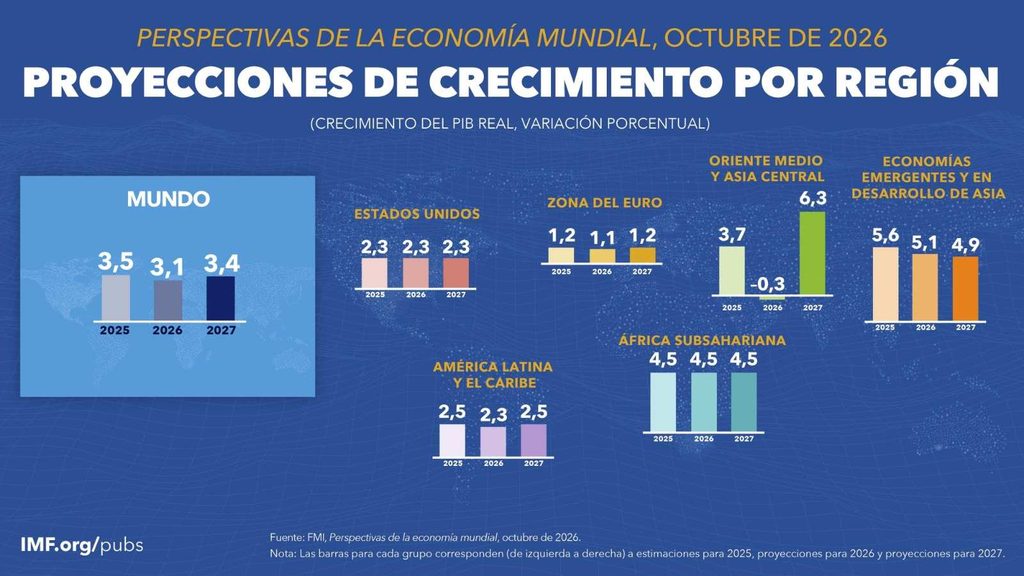
The International Monetary Fund projects a slowdown in the regional economy in 2026, followed by a moderate recovery in 2027. Brazil and Mexico show diverging trajectories, while global growth is also expected to lose momentum this year.
Latin America and the Caribbean are projected to record economic growth of 2.3% in 2026 and 2.5% in 2027, according to International Monetary Fund (IMF) projections published in the october 2026 World Economic Outlook report. The figures indicate a slowdown compared to the 2.5% recorded in 2025 but anticipate a recovery of two-tenths of a percentage point the following year.
According to the organization’s estimates, the region’s growth would remain below that of emerging and developing asian economies, which are projected to grow by 5.1% in 2026 and 4.9% in 2027. It would also trail behind Sub-Saharan Africa, where expansion of 4.5% is projected for both years. These differences reflect the fact that the pace of economic growth will vary across the world’s regions.
The regional outlook is unfolding against a backdrop of international uncertainty, characterized by geopolitical and trade tensions, fluctuations in energy prices, and shifts in technology investment. Although the IMF acknowledges the global economy’s resilience in the face of shocks, it warns that risks remain tilted toward lower growth.

Brazil’s growth to slow, Mexico’s to accelerate
Among Latin America’s major economies, Brazil is projected to record growth of 2.2% in 2026, down from 2.3% in 2025. For 2027, the IMF forecasts a further moderation in expansion to 1.9%, signaling a gradual loss of momentum over the period analyzed.
Mexico would follow a different trajectory, characterized by a progressive recovery. After growing 0.5% in 2025, its economy is expected to expand by 1.5% in 2026 and 1.8% in 2027. Although these projections show an improvement over the previous year, growth would remain below the average forecast for Latin America and the Caribbean in 2027.
The figures indicate that economic performance across the region will be uneven. While Mexico is expected to accelerate its pace of expansion, Brazil is likely to experience a slowdown. However, the IMF’s outlook does not include individual projections for every country in Latin America and the Caribbean; therefore, the regional average should not be interpreted as the expected growth rate for each specific economy.
Global economy projected to grow by 3.1% in 2026
On a global scale, the IMF forecasts that world gross domestic product (GDP) will grow by 3.1% in 2026, down from the 3.5% estimated for 2025. For 2027, the organization anticipates a rebound to 3.4%, signaling a partial recovery in the pace of expansion.
Growth in advanced economies is projected to rise from 2% in 2025 to 2.1% in 2026, before moderating to 1.8% in 2027. The United States is expected to maintain an expansion rate of 2.3% throughout the three-year period, while the euro area is projected to grow by 1.1% in 2026 and 1.2% in 2027.
Meanwhile, emerging market and developing economies are expected to record growth of 3.7% in 2026, down from 4.5% in 2025. The IMF projects a recovery to 4.4% by 2027. Within this group, China is forecast to grow by 4.5% in 2026 and 4% in 2027, while India is expected to see expansion of 7% in both years, according to the projection data.

Inflation and trade tensions sustain uncertainty
The IMF also projects a rise in global headline inflation to 4.7% in 2026, followed by a moderation to 4.1% in 2027. The institution warns that energy-importing economies outside the technology value chain would face more challenging prospects.
Among the key risks to global growth, the report cites a potential escalation of geopolitical conflicts, a recalibration of expectations regarding artificial intelligence, a flare-up in trade tensions, and fiscal vulnerabilities. These factors could affect investment decisions, international trade, and governments’ capacity to respond to new crises.
Conversely, increased investment in artificial intelligence and associated productivity gains, along with a sustained easing of geopolitical and trade tensions, could bolster global economic growth.
IMF recommends strengthening fiscal frameworks
Given this scenario, the organization proposes that governments strengthen their fiscal frameworks to respond more effectively to economic shocks. Its recommendations include preserving price signals and providing temporary, targeted aid to the most vulnerable households during cost-of-living crises.
The report also notes that changes to corporate income taxes can have varying effects both domestically and abroad, depending on how they are funded. Debt-financed tax cuts may stimulate domestic activity but can also generate short-term negative effects on other economies and reduce resources available for public investment.
For Latin America and the Caribbean, projections point to moderate growth of 2.3% in 2026, rising to 2.5% in 2027. The challenge will be to sustain productive activity and attract investment in an uncertain international environment without compromising governments’ fiscal capacity to address economic and social needs.
The IMF’s estimates are based on statistical data available as of october 1, 2026, and are subject to change as new economic data becomes available.
Read also: