

 dinero_admin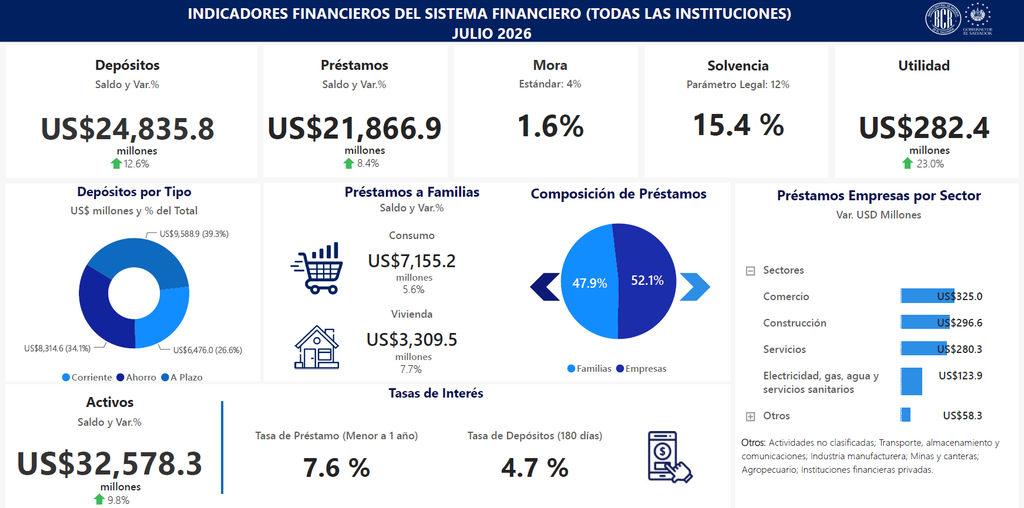
The salvadoran financial system maintains a strong capacity to continue providing loans to families and businesses. According to data from the Banco Central de Reserva (BCR), as of the end of july 2016, deposits reached US$24,835.8 million and the loan portfolio totaled US$21,866.9 million, placing the loan-to-deposit ratio at 88%.
This indicator means that for every US$100 deposited in the financial system, approximately US$88 have been allocated as loans. According to the BCR, this proportion reflects a healthy balance between lending activity and available liquidity, allowing financial institutions to continue financing households and businesses without compromising their ability to meet their obligations to depositors.
Deposits continue to be the main source of financing for the financial system. Its year-on-year growth of 12.6% surpassed the 8.4% increase registered by the loan portfolio, strengthening the availability of resources to boost new financing operations.

Data from the BCR shows that credit growth was primarily driven by productive activities. The largest increases were recorded in the trade sector, with an additional US$325 million; construction, with US$296.6 million; and services, with US$280.3 million. These sectors account for a significant portion of the credit expansion observed over the past twelve months.
Financing to households also maintained a positive trend. Consumer loans reached US$7,155.2 million, while housing loans totaled US$3,309.5 million. According to the Banco Central, the growth in loans to households recorded in july was the highest in the last 30 months.

In addition to the loan-to-deposit ratio of 88%, other indicators reflect the strength of the financial system. The delinquency rate stood at 1.6%, below the benchmark of 4%; solvency reached 15.4%, above the legal minimum of 12%; and profits totaled US$282.4 million, a 23% increase compared to the same period of the previous year.
For the BCR, these results demonstrate that the Salvadoran financial system maintains favorable conditions of liquidity, solvency, and profitability, allowing it to continue fulfilling its role as a financial intermediary and supporting economic growth by financing businesses and households.
You can also read: