


 dinero_admin
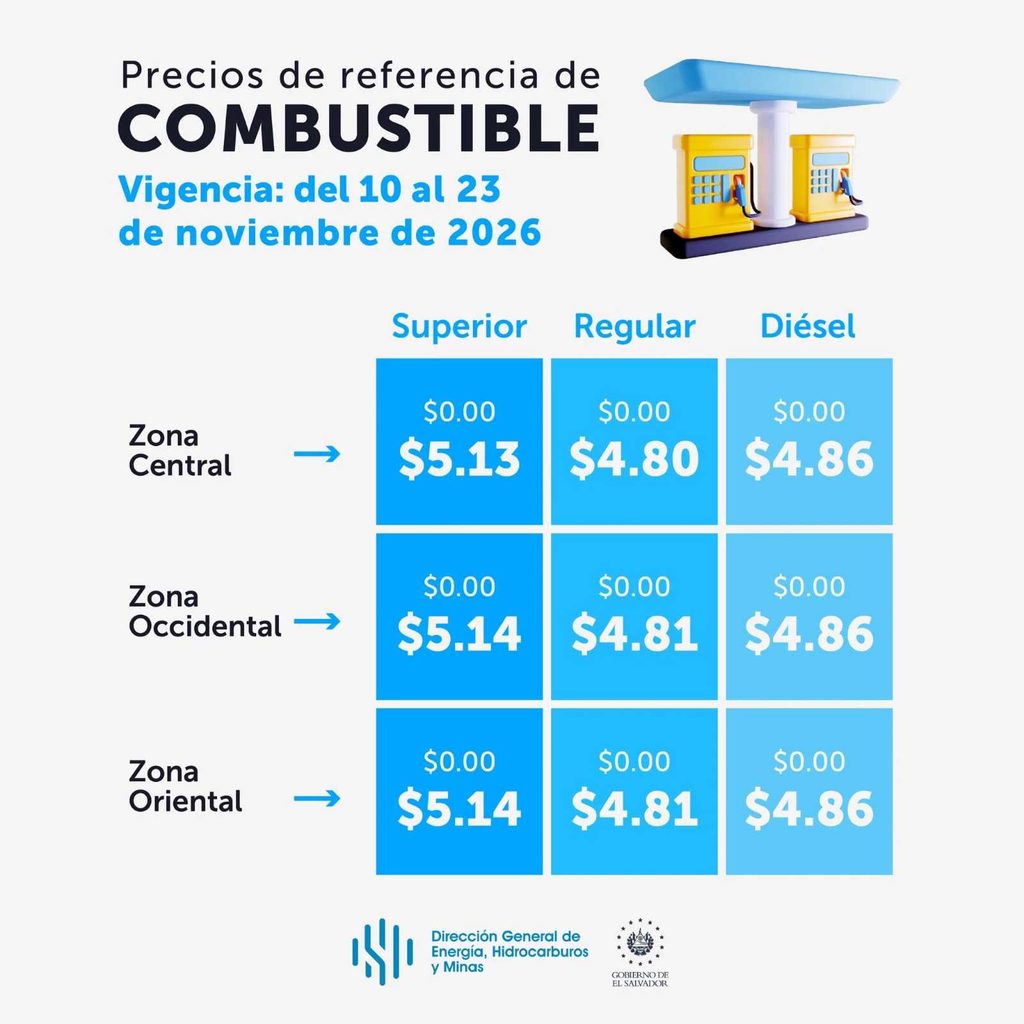
Reference fuel prices in El Salvador will remain unchanged for the fourth consecutive week, according to the Dirección General de Energía, Hidrocarburos y Minas (DGEHM). These rates will be in effect from november 10 to 23, 2026, meaning drivers will continue to pay the same prices per gallon for Premium, Regular, and diesel.
According to the DGEHM, in the central region of the country, Premium gasoline will be sold at a reference price of US$5.13 per gallon, while Regular will remain at US$4.80. Diesel will remain at US$4.86, unchanged from the previous period.
In the western region, Premium gasoline will be priced at US$5.14 per gallon and Regular at US$4.81. Diesel will remain at US$4.86. These rates also show no increases or decreases.
Meanwhile, in the eastern region, prices will be the same as in the western region: US$5.14 for Premium gasoline, US$4.81 for Regular, and US$4.86 for diesel. The DGEHM confirmed that the price variation for all three products is US$0.00 across all regions of the country.
International factors maintain uncertainty
The institution explained that price stability occurs within a context of uncertainty in the international hydrocarbon market. Among the factors influencing oil price expectations is the decrease in crude oil exports through the Strait of Hormuz, a situation that has generated concern in international markets.
Added to this scenario are the US attacks on Qeshm Island, which have heightened tensions with Iran and impacted expectations regarding international oil and petroleum product prices. Furthermore, the continued decline in US oil inventories during october has contributed to market uncertainty.
Despite these conditions, the indicated that coordinated efforts between the government and oil companies have allowed for stable gasoline and diesel prices for salvadoran consumers. It also highlighted that the country remains among the most competitive fuel markets in the region.
The institution added that it has reinforced inspections at service stations to verify that fuels meet quality standards and that consumers receive exactly the amount they pay for. Inspectors also maintain constant monitoring of companies that market petroleum products and warn that establishments that fail to comply with regulations are subject to the corresponding penalties.
You can also read: