


 Redacción Dinero.com.sv
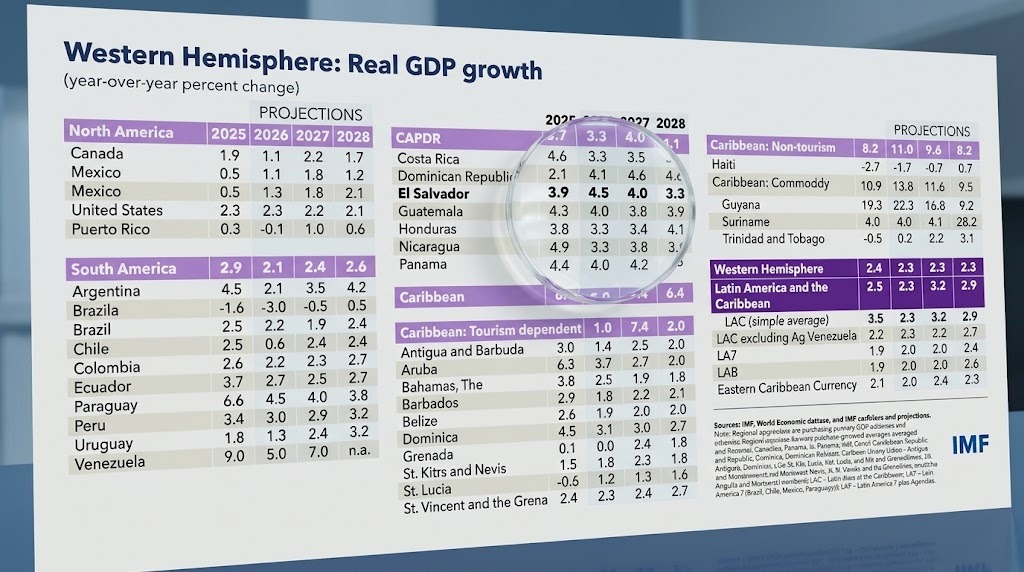
The International Monetary Fund (IMF) projects that El Salvador’s economy will grow by 4.5% in 2026, an improvement compared to the 3.9% recorded in 2025. According to the organization’s estimates, the country would maintain an expansion rate of 4% in 2027, although growth is expected to moderate to 3.3% in 2028. These figures place El Salvador among the economies with the strongest growth prospects in Latin America and the Caribbean.
According to the IMF’s projections, El Salvador’s economic growth in 2026 would exceed the forecast average for Latin America and the Caribbean, estimated at 2.3%, as well as the 2.2% projected for the Americas as a whole. In 2027, El Salvador would achieve 4% growth, compared to 2.5% for Latin America and the Caribbean. Meanwhile, in 2028, the national economy would grow by 3.3%, above the 2.9% forecast for the region.
El Salvador would maintain growth above the regional average
For Central America, Panama, and the Dominican Republic (CAPRD), the IMF estimates combined growth of 4.2% in 2026, which would decline to 4% in 2027 and reach 4.1% in 2028. Within this group, the Dominican Republic is expected to expand by 4.6% in 2026, while Panama would reach 5%, Guatemala would grow by 4%, and Honduras by 3.3%. These figures reflect varying growth prospects among Central American economies and their neighboring countries.
At the regional level, the international organization expects Latin America and the Caribbean to maintain moderate growth, with rates of 2.3% in 2026, 2.5% in 2027, and 2.9% in 2028. IMF Managing Director Kristalina Georgieva noted in a post on X that the region’s economy continues to demonstrate resilience, driven by factors such as strong demand from the United States, commodity prices, tourism, and remittances, which help offset trade and geopolitical pressures.
Latin America is expected to grow at a moderate pace as inflation continues to decline
Meanwhile, South America is expected to record growth of 2.1% in 2026, followed by a recovery to 2.4% in 2027 and 2.8% in 2028. Among the economies in this area, Paraguay has the highest projections for 2026, with growth of 4.5%, while Peru is expected to reach 3%, Ecuador 2.7%, Colombia 2.2%, and Brazil 2.2%. Argentina, meanwhile, is projected to expand by 2.1% that year.
In North America, the IMF estimates that the United States will grow by 2.3% in both 2026 and 2027, while growth of 2.1% is projected for 2028. Mexico is expected to expand by 1.5% in 2026, increasing to 1.8% in 2027 and 2.2% in 2028. The performance of these economies is also relevant to Latin America because of their trade relations and demand for goods and services from the region.
Regarding inflation, the IMF expects El Salvador to close 2026 with an inflation rate of 3%, following the 0.9% estimated for 2025. However, the indicator would decline to 2.1% in 2027 and 1.8% in 2028. For Latin America and the Caribbean, inflation is expected to stand at 6.8% in 2026, falling to 5% in 2027 and 4.1% in 2028, although significant differences between countries remain.
The organization’s projections offer a favorable growth outlook for El Salvador over the coming years, particularly compared to the regional average. Nevertheless, economic performance will depend on external factors such as developments in international trade, commodity prices, geopolitical conditions, and the performance of its main trading partners. The IMF highlights that U.S. demand, tourism, and remittances will continue to be important factors in sustaining economic activity across Latin America and the Caribbean.