

 dinero_admin
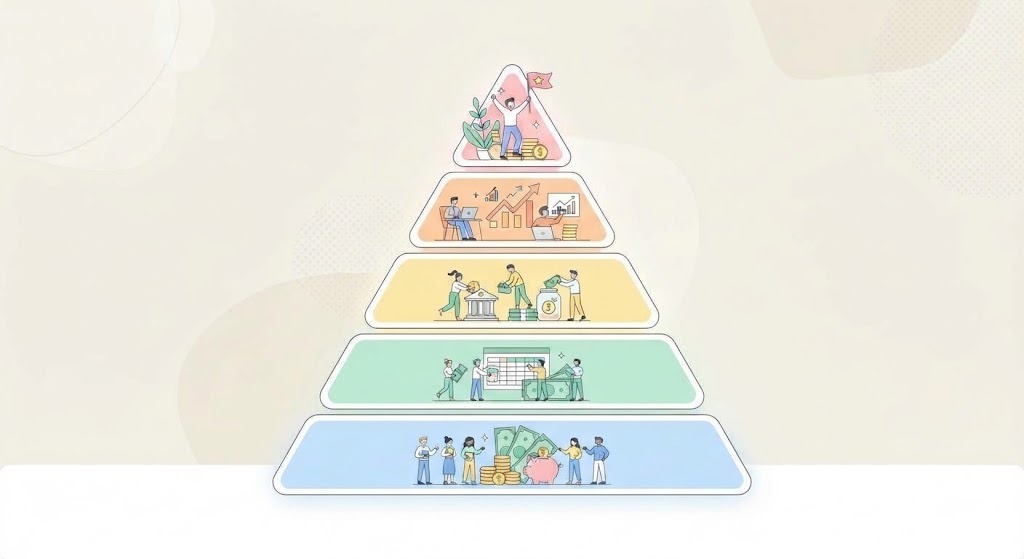
Financial health does not depend solely on how much money a person earns; it also hinges on how they manage their income, how much they save, what debts they carry, and whether they have the resources to handle unforeseen events. To better understand this process, there is the “financial pyramid”, an educational model that helps identify the various stages of economic organization, ranging from covering basic needs to building wealth and achieving greater financial independence.
While there is no universal or official classification for this pyramid, its levels help organize economic priorities and clarify which areas need strengthening before moving toward new goals. It is generally divided into five stages: survival, stability, security, growth, and financial freedom.
The five levels of the financial pyramid
The first level is survival, where income is primarily used to cover basic needs such as food, housing, transportation, and utilities. Individuals at this stage often struggle to make ends meet, lack savings, and may need to rely on loans to cover daily expenses. The priority here is to create a budget and learn how to allocate money effectively.
The second level is financial stability. At this stage, there is greater control over income and expenses; monthly obligations are met, and there is no longer a constant reliance on credit. Although debts may still exist, the individual knows exactly how much they own and has a plan to pay it off without compromising their ability to meet basic needs.
The third level is financial security, which involves having a financial cushion to handle unexpected situations. At this stage, an emergency fund becomes essential, ideally, one that covers three to six months of basic living expenses. It is also advisable to consider protective measures, such as health, life, or home insurance, depending on individual needs.
The fourth level is financial growth. At this point, an individual has achieved greater stability and can allocate a portion of their income toward savings and investments. During this stage, one might explore options such as fixed-term deposits, bonds, or investment funds, while considering personal goals, time horizons, and risk tolerance. The goal is not just to set money aside, but also to ensure it has the potential to generate returns.
Finally, there is financial freedom, the stage where accumulated resources and various income streams allow you to cover your personal needs without relying solely on a salary. This can be achieved through investments, real estate, businesses, or other assets that generate sustainable income and help build wealth.
How can you determine your current financial level?
To identify which stage your finances are in, it is important to evaluate certain habits and economic conditions. For example, ask yourself whether your income covers your monthly expenses, whether you have outstanding debts, whether you save regularly, and whether you have funds available to handle an emergency. You should also consider whether you have investments or additional sources of income.
Your answers will help you identify which areas need strengthening. A person might have a stable job and a steady monthly income, but if they spend everything they earn and have no savings, they still need to work on their financial security. Likewise, having investments does not necessarily mean you have achieved financial freedom if you carry significant debt or lack proper planning.
Moving between these levels does not depend solely on earning more money; it requires developing habits such as creating a budget, controlling expenses, reducing unnecessary debt, and setting savings goals. It is also important to start with manageable amounts and gradually increase your savings capacity in line with your available income.
The financial pyramid helps us understand that building a healthy financial life is a gradual process. Identifying your starting point helps you make better decisions, set priorities, and work toward goals that lead to greater stability and economic well-being.
You may also want to read: