

 dinero_admin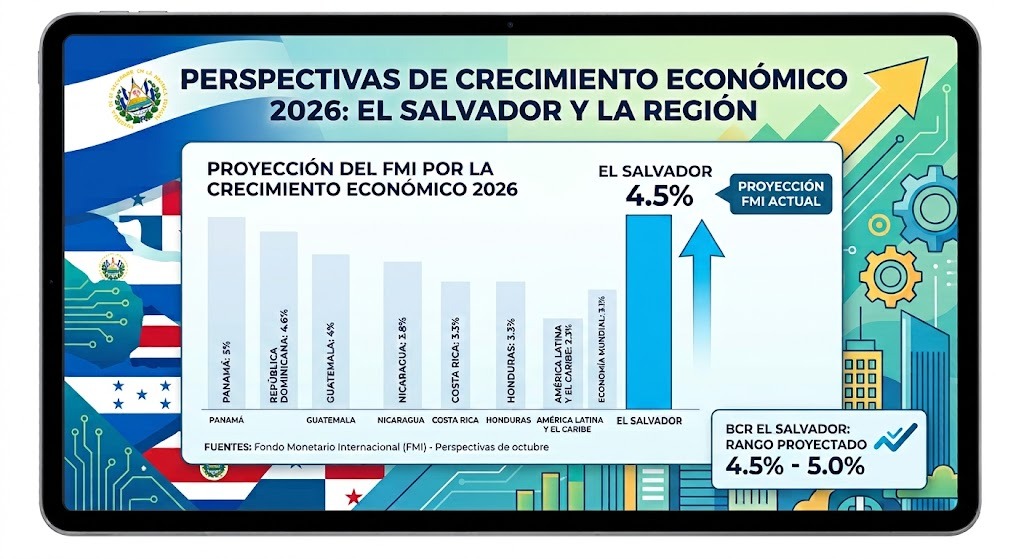
The International Monetary Fund (IMF) has upgraded its growth forecast for the salvadoran economy, now estimating that the country’s Gross Domestic Product (GDP) will increase by 4.5% by the end of 2026. This new projection represents an improvement over the 3.3% figure the organization calculated in april and points to an economic performance stronger than that recorded last year, when the country grew by 3.9%.
This update places El Salvador’s growth outlook above the forecasts for the global economy and for Latin America and the Caribbean. According to figures cited in the report, global economic activity is projected to grow by 3.1% in 2026, while the Latin American and Caribbean region is expected to expand by 2.3%. This means that the projection for El Salvador exceeds the global estimate by 1.4 percentage points and the regional estimate by 2.2 percentage points.
The adjustment also indicates that the outlook for El Salvador has improved by 1.2 percentage points compared to the april estimate. This revision reflects a more favorable expectation regarding economic activity throughout the year. However, this remains a projection rather than a definitive outcome, as actual growth will depend on how the economy evolves over the coming months.
Within Central America, El Salvador is positioned as the economy with the second-highest projected growth, trailing only Panama, for which the IMF anticipates an expansion of 5%. The organization estimates 4% growth for Guatemala, while Nicaragua is expected to reach 3.8%. Costa Rica and Honduras are both projected to see growth of 3.3%, according to data from the october economic outlook.
Looking at the broader context of Latin America and the Caribbean, the Dominican Republic also stands out with a growth projection of 4.6%, slightly higher than that of El Salvador. Even so, the projected 4.5% growth for El Salvador places it among the economies with the best expansion prospects in the region, against a backdrop where the IMF estimates an average regional growth rate of 2.3%.
Meanwhile, the Banco Central de Reserva (BCR) maintains a favorable outlook for the salvadoran economy, estimating that GDP could grow by between 4.5% and 5% by the end of 2026. The lower end of this range aligns with the IMF’s forecast, while leaving open the possibility of greater economic expansion should the conditions factored into official estimates be met.
GDP growth measures the increase in a country’s production of goods and services over a specific period. Higher economic expansion can reflect greater dynamism in productive activities, trade, and services, though it does not automatically mean that all households will experience a corresponding rise in income. Therefore, alongside the growth rate, it is important to monitor trends in employment, investment, and the population’s consumption capacity.
Based on these forecasts, El Salvador heads toward the end of 2026 with growth expectations that exceed those of the previous year, as well as global and Latin American averages. Economic performance in the coming months will determine whether the country achieves the 4.5% expansion projected by the IMF or approaches the upper limit of the range estimated by the BCR.
You may also read: