

 dinero_admin
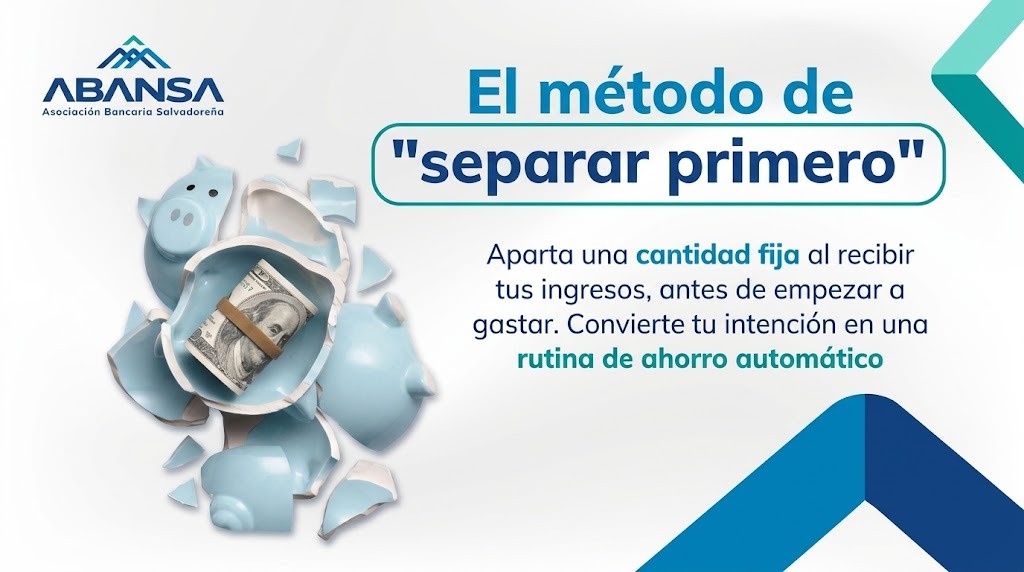
The Asociación Bancaria Salvadoreña (ABANSA) recommends adopting the “set aside first” method to strengthen savings and improve personal financial management. This strategy involves reserving a fixed amount of money as soon as income is received before paying for other expenses, thereby making savings a priority within one’s monthly budget.
This approach shifts away from the traditional way of managing money, where many people wait until all expenses are covered to save only what remains at the end of the month. By setting aside a portion of one’s income first, saving no longer depends on what happens to be left over after daily purchases and payments; instead, it becomes a planned, intentional habit.
To put this into practice, the first step is to review your total monthly income and the amount allocated to essential needs, such as food, housing, transportation, utilities, and debt payments. Based on this analysis, you can determine a realistic and sustainable savings amount that does not compromise your ability to meet essential obligations. The goal is not to set aside an amount that is difficult to maintain, but rather to choose a sum that can be consistently put away.
Once the amount is determined, it is best to set it aside on the very day you receive your salary or any other form of income. This can be done by using a dedicated savings account or another mechanism that keeps these funds separate from money intended for daily expenses. If possible, setting up automatic transfers simplifies the process and reduces the risk of spending the money due to a lack of planning.
Consistency is a core element of this strategy. Even if the amount set aside is small at first, maintaining the habit allows for the accumulation of funds over time. For example, someone who saves US$20 each week can accumulate US$80 over a four-week period, not even accounting for interest or other potential returns. This illustrates how regular contributions can grow into a meaningful sum to help address future needs.
Accumulated funds can be directed toward specific objectives, such as creating an emergency fund, covering educational expenses, financing home repairs, or saving the amount needed for a planned purchase. Setting a goal helps define how much needs to be saved and for how long, while also providing a benchmark for tracking progress. A key priority might be establishing an emergency fund, which allows you to handle unexpected expenses without immediately resorting to loans or credit cards.
For this method to be effective, it is also important to periodically review your budget. If your income changes or essential expenses increase, the amount allocated for savings can be adjusted. The essential principle is to maintain a balance between current financial obligations and preparation for future needs. Furthermore, it is advisable to avoid using savings for impulsive purchases, ensuring that these resources remain available for their intended purpose.
The “set aside first” method promoted by ABANSA encourages individuals to develop a more organized relationship with their money by reserving a portion of their income before they begin spending. Turning this practice into a routine allows for gradual progress toward financial goals, strengthens one’s ability to respond to unforeseen events, and builds a financial safety net for the future, rather than relying solely on whatever money happens to be left over at the end of the month.
You may also want to read: