

 A. M.
A. M. 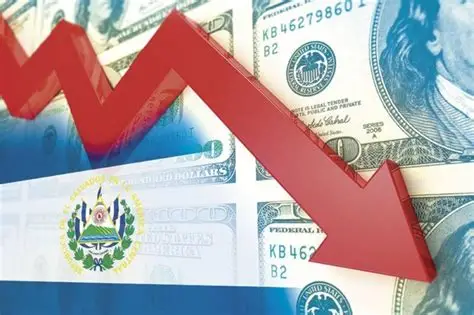
El Salvador registered a year-on-year real depreciation of 1.69% against the United States in january 2026, according to data from the bilateral Cambio Efectivo Real (ITCER) published by the Central American Monetary Council. This indicator reflects how relative prices evolve between economies and allows for the evaluation of countries’ trade competitiveness against their main partners.
Generally speaking, a real depreciation means that salvadoran products become relatively more competitive compared to US products, as local goods and services tend to be cheaper compared to those in the United States when considering the price levels of both economies.
The ITCER is an indicator that combines the exchange rate and inflation to measure the behavior of the relative cost of goods between two countries. In the case of El Salvador, which uses the dollar as its official currency, changes in this index are mainly explained by differences in inflation between the salvadoran and US economies, rather than by variations in the nominal exchange rate.
The data shows that real depreciation was not unique to El Salvador. Other countries in the region also experienced this trend relative to the United States during the same period. Costa Rica saw the largest depreciation at 2.87%, followed by Honduras at 1.91%, El Salvador at 1.69%, and Guatemala at 0.72%. In the Caribbean, the Dominican Republic registered a depreciation of 0.44%.
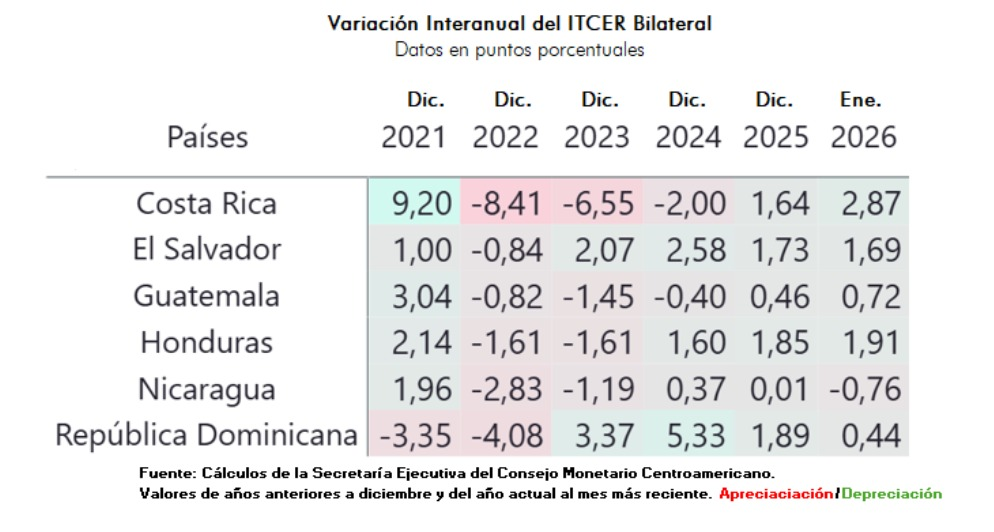
In contrast, Nicaragua was the only country in the group to experience real appreciation, with a variation of -0.76%, indicating that its goods and services became relatively more expensive compared to those in the United States.
The behavior of the ITCER also shows a medium-term trend for El Salvador. According to regional statistics, the index rose from 103.63 in 2024 to 105.42 in 2025 and reached 105.52 in january 2026, reflecting gradual changes in the country’s relative competitiveness compared to the United States.
For economists and analysts, these variations are often interpreted as signals about external competitiveness, especially in export sectors such as manufacturing, agribusiness, and services. When the index reflects real depreciation, exports can gain competitiveness, while appreciation tends to make local products more expensive in international markets.
The ITCER is used by economic organizations and central banks in the region as a tool to monitor the competitive position of economies and assess the impact of inflation and international trade conditions. In the case of El Salvador, its evolution is closely linked to the behavior of domestic prices and the inflationary dynamics of the United States, its main trading partner.
You can also read: