

 dinero_admin
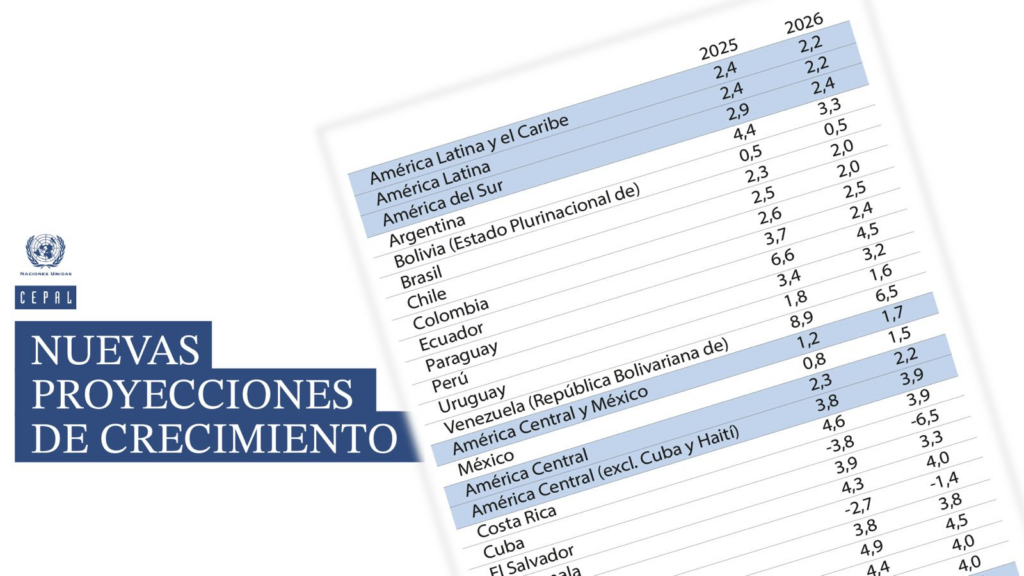
The economies of Latin America and the Caribbean will register an average growth of 2.2% in 2026, according to the most recent update of projections presented by the Comisión Económica para América Latina y el Caribe (CEPAL). This figure represents a slight revision compared to the 2.3% estimated in december 2025, reflecting a more complex international panorama than predicted.
According to the regional organization of the United Nations, less economic dynamism will be widespread in the region. Of the 33 countries analyzed, 24 will experience a slowdown in their growth, while only seven will show an improvement. If these projections are confirmed, Latin America and the Caribbean would accumulate four consecutive years with rates around 2.3%, demonstrating a limited capacity for economic expansion.
One of the key factors behind this slowdown is the deterioration of the international context. CEPAL indicates that the increase in geopolitical tensions, especially in the Middle East, has increased global uncertainty and volatility in financial and raw materials markets. Added to this is the increase in oil prices, whose average price in April rose significantly above the levels recorded at the end of 2025, generating inflationary pressures at a global level.
The rise in food prices and the slowdown of important commercial partners such as Europe, China and India also had an influence on this scenario. Furthermore, international trade shows less dynamism: the World Trade Organization projects that global trade volume will grow by 2.7% in 2026, down from the 4.7% recorded in 2025.
In this context, the main central banks have opted to maintain more cautious monetary policies, which has resulted in more restrictive financial conditions than expected. This has a direct impact on investment and consumption, the key drivers of economic growth.
At an internal level, CEPAL warns that growth will be limited mainly by a lower dynamism in private consumption. Although the reversal is a sign of recovery, its progress continues to be moderate in most countries. This trend has been observed since the second half of 2025, especially in the region’s largest economies.
At the same time, regional inflation could exceed 3%, driven by an increase in energy costs, food costs and volatility in several countries, especially in South America.
Economic performance will be uneven between countries and subregions. New countries managed to grow by more than 4%, while others reached between 3% and less than 4%. In contrast, 13 economies grew at a lower level and three registered contractions.
By subregions, South America is projected to grow by 2.4% in 2026, down from 2.9% in 2025. In Central America, growth would be 2.2%, slightly lower than the 2.3% of the previous year, although excluding Cuba and Haiti, the average would rise to 3.9%. In the Caribbean, growth reached 5.6%, driven mainly by Guyana’s performance; Without this country, the regional average would be considerably lower.

CEPAL also warns about risks that could affect these projects further. Among them, they highlight the persistence of restrictive financial conditions, the increase in inflation, the volatility of international markets and the weakness of domestic demand in several economies. This includes structural factors such as limitations in economic policies and institutional weaknesses in some countries.
Finally, the organization understands that the current scenario highlights structural challenges in the region, such as low sustained growth and high vulnerability to external factors. In this context, it considers it essential to strengthen the internal growth engines, boost investment, improve productivity and strengthen the response capacity in the face of an increasingly uncertain global environment
You can also read: