

 dinero_admin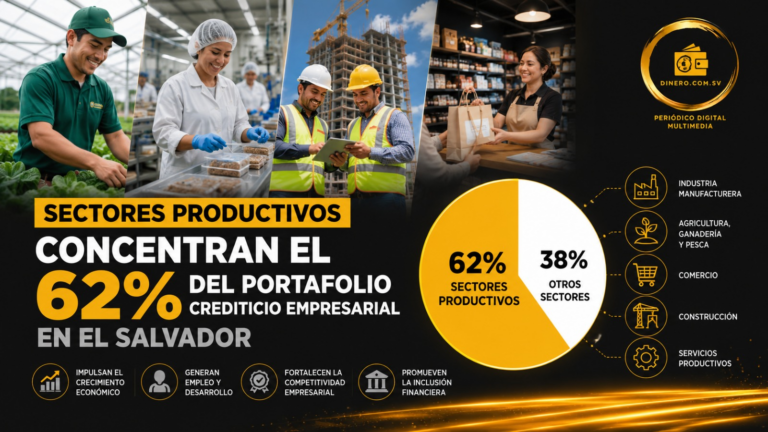
The salvadoran financial system maintains a positive trend in loan disbursement, with a significant boost to the economy’s productive sectors. According to the Banco Central de Reserva (BCR), during the first five months of 2026, construction, commerce, services, and manufacturing accounted for 62% of the productive loan portfolio, reflecting the dynamism of these strategic areas.
According to data from the financial system, credit reached a balance of US$21,626.0 million, registering year-on-year growth of 8.1%, equivalent to an additional US$1,623.8 million compared to the same period of the previous year.

This growth in financing was led by the business sector, which expanded by 10.5%, representing an increase of US$1,071.2 million. This performance was mainly related to the increased demand for resources for productive activities and investment projects.
Within this segment, construction, commerce, services, and manufacturing stood out as the most dynamic sectors, accounting for 62% of the productive portfolio and becoming the main recipients of financing to strengthen their operations, expand their capabilities, and generate new economic opportunities.

Likewise, financing for households registered year-on-year growth of 5.6%, equivalent to an additional US$552.6 million, driven by an increase in housing loans, which grew by 6.7%, and consumer loans, with a 5.2% increase.
Deposits reached US$24,632.1 million, with year-on-year growth of 14.9%, reflecting salvadorans’ confidence in financial institutions and strengthening the system’s capacity to continue supporting economic activity.

Stability indicators also show favorable conditions: the delinquency rate remains at 1.6%, below the prudential limit of 4%, while the solvency ratio stands at 15.1%, above the legal minimum of 12%.
With these results, the financial system continues to play a fundamental role in the country’s economic development by channeling resources to productive sectors that drive investment, employment, and growth.
You can also read: