

 dinero_admin
El Salvador’s sovereign bonds saw a significant price increase in international financial markets, reflecting renewed investor interest in the country’s debt. President Nayib Bukele shared Bloomberg charts illustrating this trend and emphasized that the high demand for these instruments is a sign of confidence in the nation’s economic direction. “Don’t bet against El Salvador,” the president wrote when sharing the information.
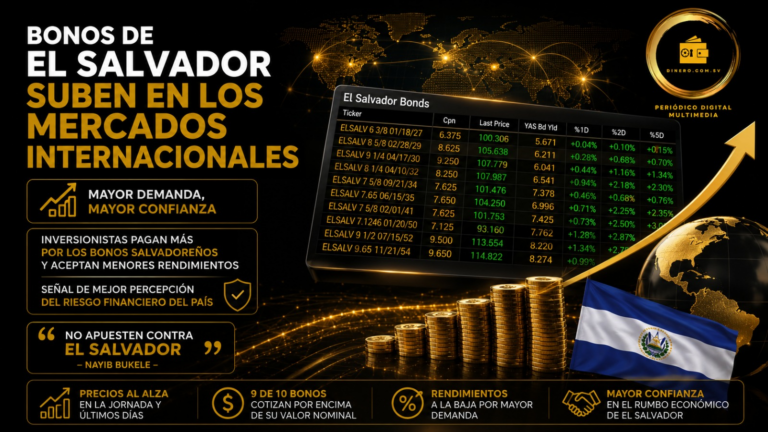
According to the published data, the main salvadoran bonds saw price increases throughout the day and have also accumulated gains in recent days. Most of the bonds are trading above their face value—that is above 100—while investors are accepting lower yields to acquire them. In fixed-income markets, this behavior is usually interpreted as an improvement in the perceived risk of an issuer, since higher demand drives up bond prices and reduces the yield they offer.
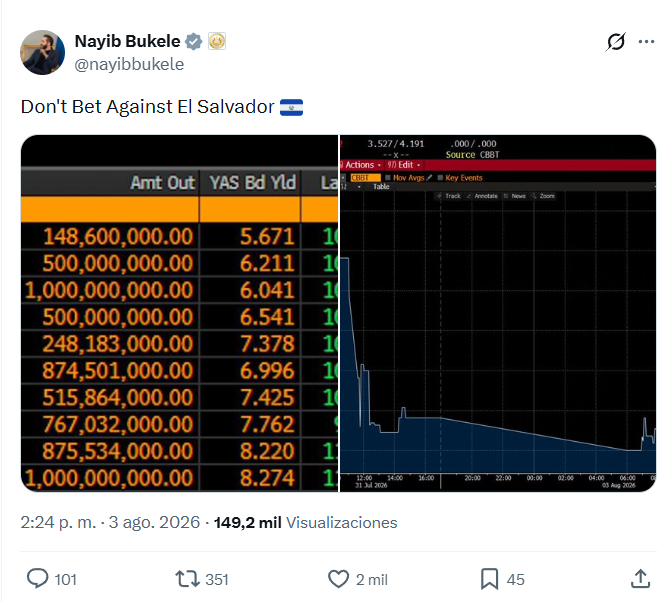
Among the best-performing instruments are the bonds maturing in 2030 and 2032, whose prices reached 107,779 and 107,987, respectively. Likewise, the bonds maturing in 2052 and 2054 are trading at 113,554 and 114,822, reflecting high market valuation. Even the bond maturing in 2027 remains practically unchanged, with a price of 100,306, while only the 2050 bond continues below 100, although it also showed gains in its price.
This observed behavior reflects a greater willingness among investors to buy salvadoran debt. When demand for a bond increases, its price rises, and consequently, the yield it offers decreases. Simply put, this means that the markets perceive less risk associated with these securities and, therefore, are willing to accept a lower return in exchange for investing in them.
However, while this performance is considered a positive sign for the country’s financial outlook, it does not in itself imply an immediate change in household finances. Movements in the bond market primarily reflect international investors’ confidence in the government’s ability to meet its financial obligations and their expectations regarding the country’s economic and fiscal performance in the medium and long term.
For the government, this behavior strengthens El Salvador’s image in international markets, since greater investor confidence can facilitate access to financing on more favorable terms and improve the country’s perception among financial institutions and potential foreign investors. In this context, President Bukele asserted that the bonds’ performance reflects confidence in the implemented economic policies and reiterated his message: “Don’t bet against El Salvador.”
You can also read: