

 dinero_admin
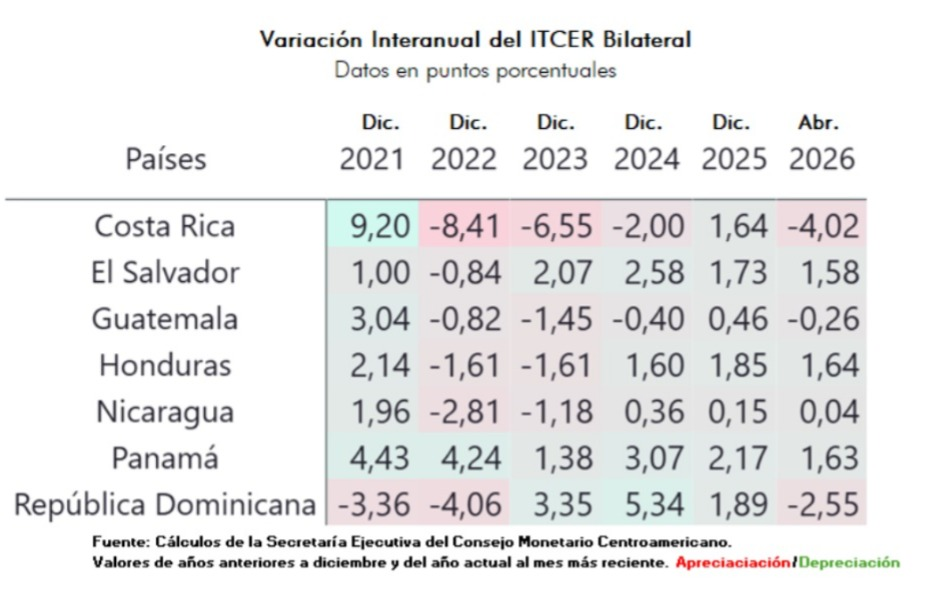
El Salvador registered a real depreciation of 1.58% in the year-on-year variation of the bilateral Real Effective Exchange Rate Index (REER) with the United States during april 2016, according to data published by the Executive Secretariat of the Central American Monetary Council (SECMCA). This result reflects an improvement in the country’s relative competitiveness compared to its main trading partner.
The REER is an indicator used to measure the competitiveness of one economy relative to another, considering variables such as price levels and other factors that influence international trade. A real depreciation is usually interpreted as a gain in competitiveness, since a country’s goods and services can become relatively more attractive compared to those of its trading partner.
In the case of El Salvador, the real depreciation of 1.58% suggests a more favorable position for salvadoran exports to the U.S. market. This is especially relevant because the United States remains the main destination for Salvadoran exports and one of the most important trading partners for the salvadoran economy.

The data also show that El Salvador has experienced three consecutive years of real depreciation against the United States. After reporting a 2.58% change in december 2024 and 1.73% in december 2025, the indicator stood at 1.58% in april 2026, remaining in a favorable position for external competitiveness.
Within the region, Honduras registered a real depreciation of 1.64%, Panama 1.63%, and Nicaragua 0.04%, while Costa Rica, Guatemala, and the Dominican Republic showed real appreciations of 4.02%, 0.26%, and 2.55%, respectively.
Real appreciation is generally interpreted as a relative loss of competitiveness, since the products of these countries may become more expensive compared to those of their trading partners. Conversely, the depreciations observed in El Salvador and other economies in the region reflect relatively more favorable conditions for competing in the U.S. market.
Although the ITCER’s performance does not, by itself, determine export performance, it is an important benchmark for evaluating a country’s competitiveness. Factors such as international demand, production costs, productivity, and logistics also influence export growth.
Nevertheless, the result reported for El Salvador represents a positive sign for the export sector, showing that the country maintains a competitive position vis-à-vis the United States, a market that accounts for a significant portion of El Salvador’s exports.
You can also read: