

 dinero_admin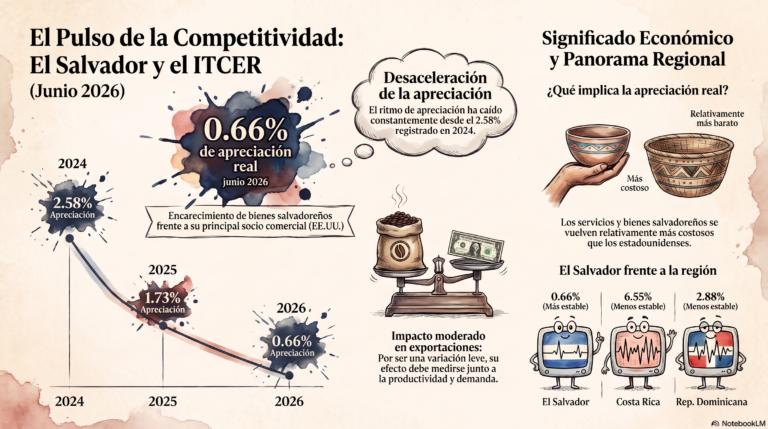
The bilateral Tipo de Cambio Efectivo Real (ITCER) between El Salvador and the United States registered a year-on-year real appreciation of 0.66% in june 2026, according to data published by the Secretaría Ejecutiva del Consejo Monetario Centroamericano (SECMCA). This indicator measures a country’s competitiveness relative to its main trading partner, considering exchange rate and inflation trends between the two economies.
A real appreciation means that salvadoran goods and services become relatively more expensive compared to those in the United States, which can pose a challenge to the competitiveness of national exports. In this case, the 0.66% appreciation is not a particularly favorable sign for external competitiveness, as it could slightly reduce the advantage of salvadoran products in the U.S. market.

However, given the moderate nature of the variation, its impact would be limited and should be analyzed in conjunction with other factors, such as productivity, production costs, and international demand.
Data shows that El Salvador’s bilateral ITCER has maintained moderate variations in recent years. After registering an appreciation of 2.58% in 2024 and 1.73% in 2025, the indicator stood at 0.66% in june 2026, reflecting a slowdown in real appreciation compared to previous years.
At the regional level, the SECMCA reported that Costa Rica, with a real appreciation of 6.55%, the Dominican Republic, with 2.88%, and Nicaragua, with 0.30%, also registered appreciations against the United States. Meanwhile, Guatemala (0.22%), Honduras (0.11%), and Panama (1.01%) showed moderate variations, demonstrating relatively stable behavior in the region.
The ITCER is one of the main indicators for evaluating the evolution of a country’s external competitiveness. Monitoring it allows us to understand how price fluctuations and other economic factors influence the ability of salvadoran products to compete in the U.S. market, the main destination for national exports.
You can also read: