

 dinero_admin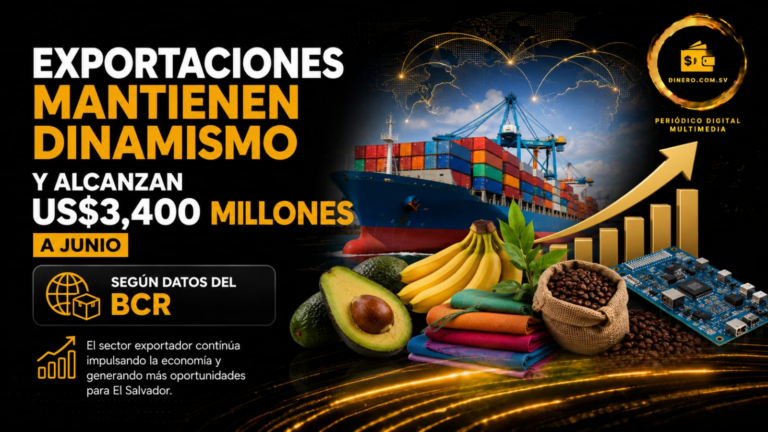
Photo: Google
Cumulative salvadoran exports through June 2026 reached US$3,400.6 million, a 4.1% increase compared to the US$3,265.7 million recorded during the same period in 2025, according to figures from the Banco Central de Reserva analyzed by the Corporación de Exportadores de El Salvador (COEXPORT).
Monthly performance also shows encouraging signs: June was the best month of the first half of the year, with exports totaling US$597.2 million and year-over-year growth of 10.5%, surpassing april’s figures (US$584.4 million, +9.3%). February was the only month to post a year-over-year decline (-1.8%), affected by a sharp, one-time contraction in sugar exports.
“This growth confirms that El Salvador’s export sector is diversifying toward sectors with higher value added, although not all sectors are performing equally well. This is a time to recognize the progress made and to focus on the sectors that need support”, said COEXPORT President Silvia Cuéllar.

By category, traditional products—primarily coffee and sugar—posted the highest percentage growth, rising 23.0%, driven by high international prices, although they account for just 8.6% of total exports. Non-traditional exports, which account for 78.1% of the export basket, grew at a more moderate rate (+2.8%), while maquila exports rose 2.1% overall.
Agribusiness was the sector with the highest growth in absolute terms (+13.6%), accounting for 17.0% of total exports—its highest share during the period. Other notable sectors included machinery and mechanical equipment (+27.1%), metalworking (+13.5%), chemical and pharmaceutical industries (+10.4%), and mineral products (+11.8%), all of which exceeded the overall average growth rate.

Photo: Google
In contrast, textiles and apparel—the country’s largest sector, accounting for 26.5% of total exports—fell by 6.6% (–US$63.7 million), marking the largest absolute decline for the period. Food and beverages also declined (-6.2%). Within the maquila sector, the textile segment fell by 14.2%, while other maquila products—led by micro electrical capacitors—grew by 39.5%, partially offsetting that decline within the sector.
“The decline in demand for the textile industry is nothing new, but these figures confirm that it requires a specific competitiveness strategy. At the same time, we are pleased to see how other sectors are gaining ground and diversifying what El Salvador sells to the world”, said Cuéllar.

Photo: Google
The United States remains the top destination for salvadoran exports, accounting for 32.5% of the total and posting 5.1% growth. Within Central America, Guatemala (+4.1%) and Costa Rica (+4.8%) showed growth, while Honduras (-3.3%) and Nicaragua (-1.1%) saw declines. Outside the region, notable growth was seen in exports to Mexico (+24.2%), China (+30.5%), Spain (+36.3%), and Canada (+66.4%), as well as the opening of new trade routes to Morocco, Georgia, and Senegal—markets where Salvadoran exports started from zero or near-zero in 2025.
“We will continue to work hand in hand with the export sector and the authorities to strengthen the country’s competitiveness, expand markets, and support the sectors facing the greatest challenges”, concluded the President of COEXPORT.
You can also read: