


 dinero_admin
When a store announces a promotion, the discount might appear as a percentage—such as 20%—or as a fixed amount, like $20 off. Although both methods indicate savings, they do not always make it immediately clear which offer represents a larger price reduction. To compare them accurately, you must relate the discount to the product’s original price.
A percentage discount indicates what portion of the original price is being deducted. For example, if an item costs $100 and has a 20% discount, the savings amount to $20, resulting in a final price of $80. In this instance, a promotion advertising a direct $20 discount would yield the exact same result, making the two offers equivalent.
The comparison changes when products have different prices. For instance, a $50 item with a $10 discount has a price reduction equivalent to 20% of its original cost. Conversely, a $200 product with a $20 discount represents a reduction of only 10%. Although the dollar savings are greater in the second case, the reduction is proportionally higher for the first product.

To convert a dollar-based discount into a percentage, you can use a simple formula: divide the discount amount by the original price and multiply the result by 100. For example, if a product costs $80 and is reduced by $12, dividing $12 by $80 and multiplying by 100 yields a 15% discount. This calculation allows you to compare a dollar-based promotion with one already expressed as a percentage.
You can also perform the calculation in reverse. If a store offers a percentage discount, simply multiply the original price by the percentage (converted to a decimal) to determine the monetary value of the reduction. For example, a $150 product with a 15% discount results in savings of $22.50, making the final price $127.50.
A practical way to compare two promotions is to look at three figures: the original price, the discount amount, and the final price to be paid. For example, a US$300 item with a 10% discount represents a saving of $30, whereas a US$100 item with a US$20 price cut represents a proportional saving of 20%. The first discount yields a larger saving in dollar terms, but the second represents a greater reduction relative to the original price.
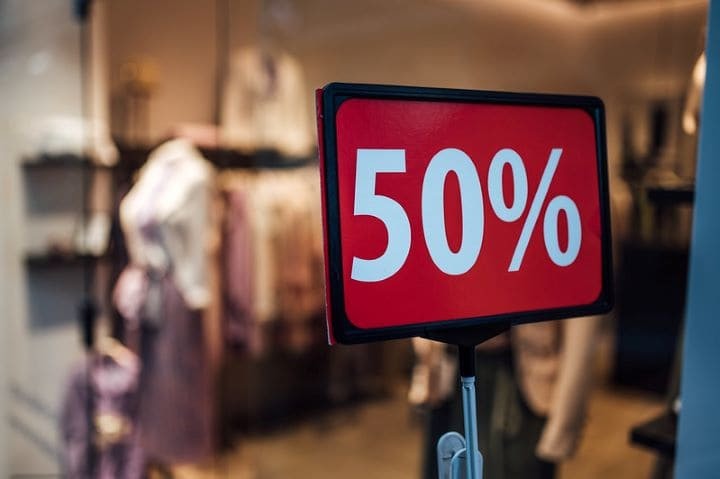
It is also important to review the terms and conditions of each promotion before deciding. Some offers require a minimum purchase, have a maximum discount limit, apply only to specific products, or require the use of a promo code. Therefore, an eye-catching percentage or a large savings amount does not necessarily reflect the final cost of the purchase.
The key is not to compare only the largest number shown in the advertisement. The percentage indicates the significance of the price cut relative to the original price, while the dollar amount shows direct savings. Converting both offers to the same unit of measurement and checking the final price makes it easier to see the true value of each promotion and to make a purchasing decision based on cost rather than just the advertising message.
You might also want to read: