

 dinero_admin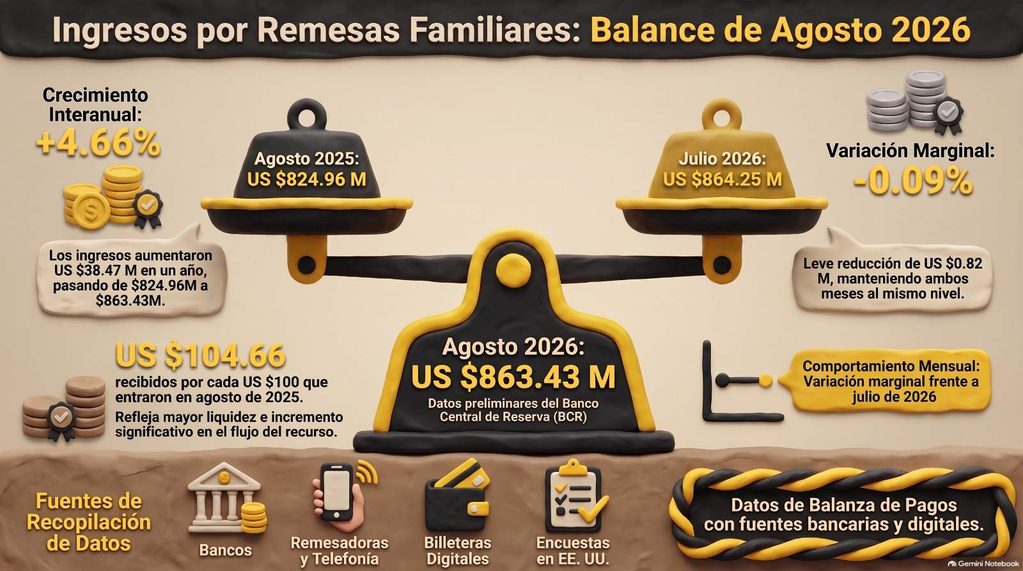
Revenue from family remittances reached US$863.43 million in August 2026, according to preliminary data from the Banco Central de Reserva (BCR). The amount was higher than that recorded in august 2025, when US$824.96 million was received, although it remained virtually stable compared to july of this year.
When comparing august 2026 to august 2025, remittance income increased by US$38.47 million, rising from US$824.96 million to US$863.43 million. This represents a year-over-year growth of 4.66%.
In other words, for every US$100 that entered the country in remittances during august 2025, approximately US$104.66 entered in august 2026. The result reflects a greater inflow of these funds compared to the same month of the previous year.
August shows a slight decline compared to july
The month-over-month comparison shows a much smaller variation. In july 2026, remittance income totaled US$864.25 million, while in august it was US$863.43 million.
This means that between july and august there was a decrease of US$0.82 million, equivalent to a negative change of just 0.09%. Therefore, although august recorded lower revenue than july, the difference was marginal, and both months remained at virtually the same level.
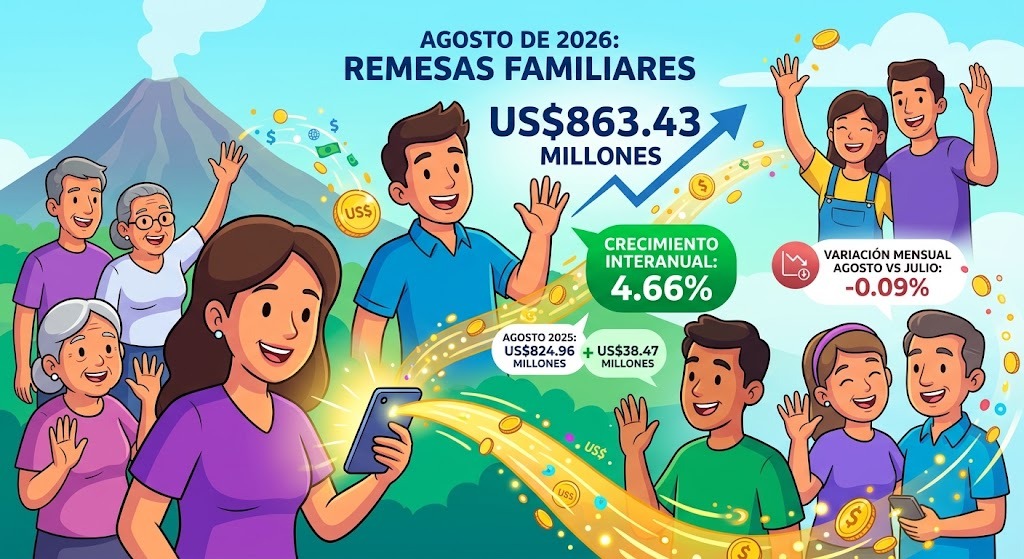
Thus, the BCR data show two trends in remittances during august: compared to august 2025, there was a 4.66% increase, while compared to july 2026, there was a 0.09% decrease.
The figures are preliminary and correspond to family remittance receipts recorded using the Balance of Payments methodology employed by the BCR. The information is provided by banks, remittance companies, federations, telecommunications companies, and digital wallet providers.
The BCR also notes that data on cash remittances, known as “pocket” remittances, are calculated based on surveys conducted in the United States. The institution further indicates that its statistics may be revised in january of each year, with adjustments covering up to three prior years, as part of its statistical quality policies and the international methodological recommendations outlined in the document.
You can also read: