


 dinero_admin
Choosing between renting or buying a home is one of the most important financial decisions for a person or family. There is no one answer that works for everyone, as the best option depends on income, savings level, job stability, debt, and future. Before deciding, it is necessary to analyze how much you can pay monthly and what impact the home will have on the family budget.
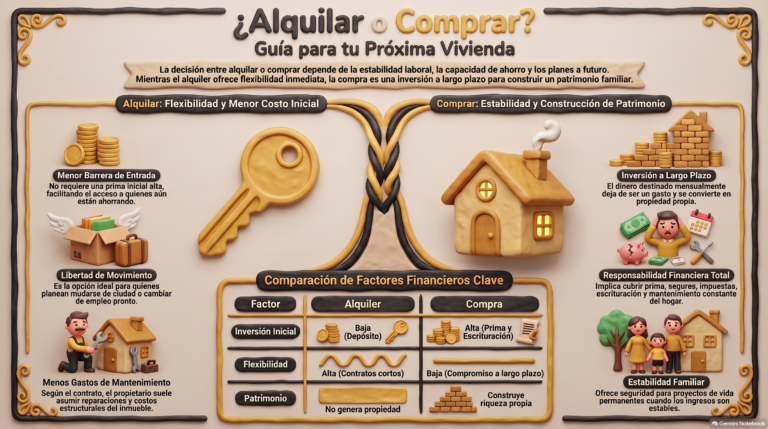
Renting can be a convenient alternative for those who do not yet have enough savings to purchase a property or need to maintain greater flexibility. The main commitment is the monthly rental payment, in addition to services, maintenance or other expenses established in the contract. One of its advantages is that it does not require raising a premium to purchase a home and, depending on the agreement, some maintenance costs may correspond to the owner.
However, renting also means that the money allocated to rent does not generate ownership of the property. Therefore, if a person has job stability, can save and plans to remain in the same place for many years, it may be advisable to evaluate the purchase of a home as an alternative to building wealth.
Buying a home involves a longer-term financial commitment. In addition to having a premium and assuming a financing fee, the buyer must consider expenses related to deed, insurance, maintenance, taxes, repairs and other costs associated with the property. Therefore, it is not enough to compare the value of a mortgage payment with the price of a rental.
One of the first steps is to review the monthly budget. Before looking for a home, it is advisable to add up your household income and subtract basic expenses, debts, food, transportation, education, services and other commitments. The money available after covering these obligations will determine how much can be allocated to housing without putting family finances at risk.
It is also important to analyze the available savings. Buying a home usually requires having resources to cover the premium and other initial expenses. If to raise that money a person would have to run out of savings or use up their entire emergency fund, it may be wiser to wait, increase savings, and strengthen their financial capacity before purchasing a property.
Income stability is another fundamental factor. A financed purchase may represent an obligation for several years, so it is important to evaluate whether income is stable enough to assume the payment even in the face of unexpected situations. Anyone with variable income should be especially careful and have an emergency fund before taking on long-term debt.
Location should also be part of the analysis. Cheaper housing, but far from work, educational centers or essential services, can generate higher transportation costs and more travel time. Therefore, the real cost of a home should not be measured only by the rent or monthly payment, but by all the expenses involved in living in a certain place.
Another point that should be considered is the length of time you expect to stay at the home. If a person plans to move cities, change jobs, or look for another home in a few years, renting can offer greater flexibility. If there is a long-term family project and you have the necessary financial capacity, buying can become a more attractive option.
It is also advisable to compare different alternatives before deciding. In the case of a purchase, different financing options, interest rates, terms, insurance, commissions and credit conditions must be reviewed. A seemingly low monthly fee can end up representing a significant cost if the term is too long or if there are other charges associated.

In the case of rental, it is advisable to carefully review the contract, know which expenses correspond to the tenant and which to the owner, verify the conditions for increasing the rent and clearly establish responsibilities related to repairs and maintenance.
Renting offers flexibility and requires fewer initial resources, while buying allows you to build wealth, but involves greater financial responsibility and a long-term commitment. The decision should not be made solely because an option seems cheaper in the short term.
Before choosing, the most important thing is to know your own financial situation, calculate how much you can really pay, maintain an emergency fund and evaluate personal and family plans. A home should represent security and stability, not a burden that forces you to sacrifice other essential expenses or assume debts that exceed your ability to pay.
You can also read: