


 dinero_admin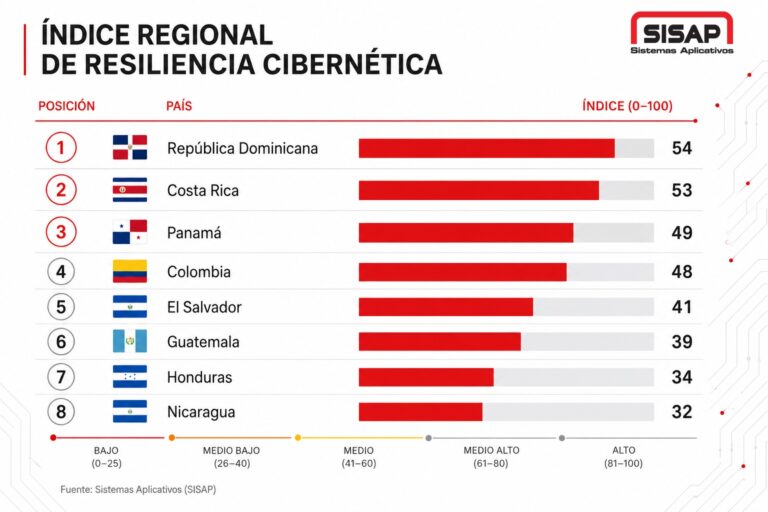
The firm warns that the Caribbean and Central America are accelerating the use of artificial intelligence, but governance and incident response preparedness are not keeping pace.
Digital transformation continues to advance in El Salvador, driving new opportunities for economic development and innovation, but also increasing cybersecurity challenges. According to SISAP’s Regional Cyber Resilience Ranking, the country has a cyber resilience index of 41%, placing it fifth in a regional comparison led by the Dominican Republic (54%), followed by Costa Rica (53%), Panama (49%), and Colombia (48%). The ranking also includes Guatemala (39%), Honduras (34%), and Nicaragua (32%).
“El Salvador continues to make progress in strengthening its capabilities to prevent, respond to, and recover from cyber incidents”. “However, threats are constantly evolving, and the adoption of artificial intelligence is accelerating, so it will be essential to continue promoting investments in specialized talent, protection technologies, and governance models that strengthen the country’s long-term cyber resilience”, said Mauricio Nanne, CEO of SISAP.
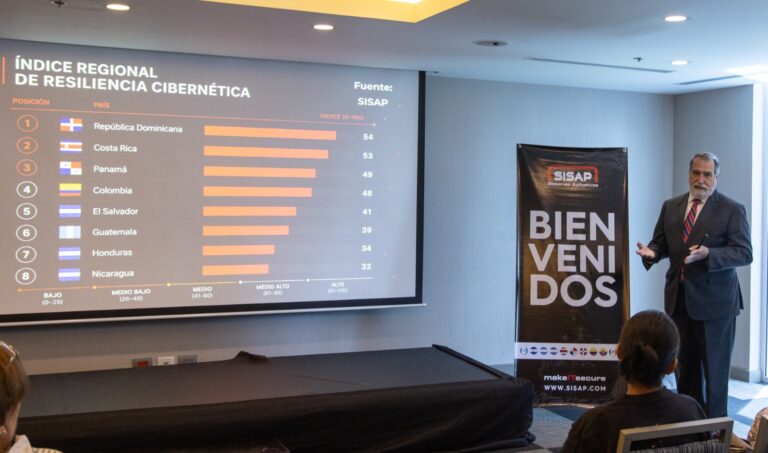
For the company, this indicator helps understand how prepared countries are to respond to and recover from digital incidents in an environment where cybersecurity already influences trust, business continuity, and competitiveness. The challenge is amplified by the expansion of artificial intelligence: Latin America already accounts for 14% of global visits to AI solutions and ranks third worldwide in downloads of generative AI applications.
SISAP warns, however, that AI adoption is not being matched by the same maturity in governance. 78% of organizations are already transforming with AI, but only 6% have the necessary security controls to do so securely (source: Trustmarque AI Governance Index). In addition, 19% of businesses lack a clearly designated AI governance officer, and 72% of AI users in companies use personal accounts.
Sectors with the greatest potential economic impact from a cyberattack
Quantifying cyber risk identifies the government, manufacturing, financial services, retail, and energy, oil, and gas sectors as the industries with the greatest potential economic impact from a cyberattack in El Salvador. The government sector leads in exposure, with potential losses of USD 167.8 million (0.61% of GDP), followed by manufacturing, with USD 156.3 million (0.57% of GDP), and financial services, with USD 111.9 million (0.41% of GDP). Collectively, these five sectors account for most of the potential national economic risk, highlighting the importance of strengthening cyber resilience in activities that are strategic for economic stability and the continuity of essential services in the country. “As digital transformation advances and operations become increasingly dependent on technology and connectivity, having tools that allow us to measure the financial impact of a cyber incident becomes a key element for anticipating risks, prioritizing investments, and strengthening business continuity”, said Estuardo Alegría, professional services manager at SISAP.
Read also: